No. 4 UConn, underperfoming Marquette tangle in Big East clash

No. 4 UConn will look to keep its dominant start to Big East conference play rolling along as the Huskies host Marquette on Sunday afternoon in Storrs, Conn.

The Christmas break did nothing to slow down the Huskies (13-1, 3-0), who took down Xavier 90-67 on Wednesday night in Cincinnati.

Alex Karaban led the way with 19 points and seven boards, while Braylon Mullins and Solo Ball each added 17. The Huskies knocked down 13 of their 28 3-point attempts (46.4%).

"I thought Alex set a tone and played a game. He's been Big East Player of the Year, All-American level player for us," Huskies coach Dan Hurley said. "Most under-appreciated great player in college basketball."

Ball leads a balanced scoring attack with an average of 15.5 points per game, with Karaban (14), Tarris Reed Jr. (14) and Mullins (10.2) not far behind. Silas Demary Jr. leads with 5.9 assists per game.

Marquette (5-9, 0-3) meanwhile is coming in off perhaps the most disappointing loss of a season that has been full of such setbacks.

The Golden Eagles held a double-digit lead midway in the second half and led by seven with three minutes left against Seton Hall on Tuesday, putting their first conference win and by far the best win of the season well in reach.

Then, the Golden Eagles missed their final 10 shot attempts and saw Seton Hall go on a 13-0 run to close out a 79-73 win in Milwaukee.

"That was as tough of an ending as I've seen in a while. There was a stretch in the second half where we were as lost in the fight and as present as we've been all season," Marquette coach Shaka Smart said. "That's a bitter, bitter pill to swallow."

With the loss, Marquette's best win on the season remains an overtime struggle against Valparaiso that it won 75-72. The Golden Eagles fell against all five Power Four opponents they faced in nonconference play and have lost second-half leads in two of their three Big East games.

Despite their struggles, Marquette does have one of the brighter talents in the Big East in Chase Ross, who leads the team with an average of 16.6 points per game.

However, even Ross' numbers have taken a dive as he had a rough month of December. Over the past five games, he is shooting 27.9% on 2-point attempts and 20% from deep.

Freshman Nigel James Jr. has led the team in conference play, averaging 17.3 points and 4.3 assists and shooting 50% from the floor across the three contests.

This was becoming one of the strongest rivalries in the Big East after Marquette took two of three from UConn in the 2022-23 season and won both the regular season and conference tournament titles.

However since then, the Huskies have won five in a row over Marquette.

The Golden Eagles have not won in a true road game at Connecticut since the 2011-12 season. UConn leads the all-time series 13-8.

--Field Level Media

No. 4 UConn, underperfoming Marquette tangle in Big East clash

No. 4 UConn will look to keep its dominant start to Big East conference play rolling along as the Huskies host Marquet...
Nancy under extreme pressure at Celtic after loss to fierce rival Rangers but says 'nothing changes'

GLASGOW, Scotland (AP) — Wilfried Nancy's job as Celtic manager came under even more intense scrutiny Saturday after a 3-1 home loss to fierce Glasgow rival Rangers in the Old Firm derby, the biggest match in Scottish soccer.

It was a sixth loss in eight games under Nancy since his arrival at Celtic on Dec. 3 and the Frenchman cut a lonely figure after the post-match handshakes as he walked down the tunnel to a backdrop of jeers that greeted the fulltime whistle.

The result left Celtic on the same points as Rangers — though ahead on goal difference — and three behind surprise leader Hearts in aturbulent campaignin the Scottish Premiership.

Nancyleft Columbus Crew in Major League Soccerfor Celtic but lost his first four matches in charge — including a stunning defeat in theScottish League Cup final. There were then back-to-back wins, only for Celtic to lose at Motherwell on Tuesday and then against its biggest foe to home.

"For me, nothing changes," Nancy said after the game against Rangers. "My focus is to help my players to be better, help my team start to be better, and to find a way to turn things around. We are really close to doing good things but (when) we concede goals sometimes it's difficult."

Trailing 1-0 at halftime, Rangers scored three goals in a 21-minute span from the 50th — leading to audible discontent among Celtic fans throughout the second half.

The BBC reported that Celtic supporters gathered outside their stadium after the game in protest at the club's board. Last month, chairman Peter Lawwell resigned and chief executive Michael Nicholson claimed three of his "colleagues" on the board were "assaulted" after the League Cup final, without disclosing further details.

Nancy cited "details at certain moments" as the reason for Celtic's problems.

"I see many, many good things — that's why the frustration is there because we deserve better," he said. "We have to stay together, and everything is going to move forward."

Celtic has been Scottish champion for 13 of the last 14 years.

Under Nancy, Celtic has conceded two or more goals in seven of his eight games in charge.

AP soccer:https://apnews.com/hub/soccer

Nancy under extreme pressure at Celtic after loss to fierce rival Rangers but says 'nothing changes'

GLASGOW, Scotland (AP) — Wilfried Nancy's job as Celtic manager came under even more intense scrutiny Saturday after ...
Theo Johnson's appearance at Knicks game raised questions after Giants TE was ruled out with an illness

Early Friday afternoon, the New York Giantsreleased their final injury reportfor Week 18 and tight end Theo Johnson was listed as "out" with an illness for Sunday's game against the Dallas Cowboys.

Hours later, Johnson was shown on the Madison Square Garden scoreboard while attending theNew York Knicks game against the Atlanta Hawks. That appearance raised questions about how the second-year tight end could be out in public despite being set to miss the Giants' season finale in two days.

Theo Johnson here at MSG for the#KnicksgameHe's out for Sunday's#Giantsgame with an illness…pic.twitter.com/0PjjOBv2Qv

— Jared Schwartz (@jschwartz115)January 3, 2026

Johnson eventook to Instagram on Friday nightand posted a story with the caption, "I am not sick."

This wasn't a case of the tanking theory that the Giants were keeping players out for a second straight week in hopes of oflanding the No. 1 overall pick in the 2026 NFL Draft. According to the team, Johnson is dealing with a non-contagious infection, "not the flu or COVID, where being around other people is a risk."

Interim head coach Mike Kafka was asked on Thursday about Johnson's week-long stay on the injury report with an illness. "So he's just still got a little bit of a sickness and just infection that we're just working through. So he's just kind of trying to clean it up, see where it goes,"he said.

Johnson was one of six Giants ruled out for Week 18, along with cornerback Cor'Dale Flott, safety Jevón Holland, offensive lineman Evan Neal, defensive lineman Rakeem Nuñez-Roches Sr. and wide receiver Wan'Dale Robinson.

The Giants needed to lose to the Las Vegas Raiders last week to secure the No. 1 pick. They did not,winning 34-10. Despite that, they still have a chance to own the top selection, but they need help in Week 18.

On Sunday, theGiants need to lose to the Cowboys, have the Raiders beat the Kansas City Chiefs, and get 1 1/2 combined wins (a tie equals half a win) from the Atlanta Falcons, Chicago Bears, Cleveland Browns, and Seattle Seahawks.

Theo Johnson's appearance at Knicks game raised questions after Giants TE was ruled out with an illness

Early Friday afternoon, the New York Giantsreleased their final injury reportfor Week 18 and tight end Theo Johnson was l...
US President Donald Trump and Venezuelan President Nicolás Maduro. - Getty Images

Expressions of unbridled power don't come blunter thanabducting a sitting presidentfrom his capital in the dead of night.

President Donald Trump has shown in a 74-word social media post that he can act decisively, suddenly and perhaps recklessly, in pursuit of his varied and varying foreign policy goals, with little regard for precedent, consequence or it seems, international law.

The operation to take Venezuelan President Nicolás Maduro and his wife from their heavily guarded location in Caracas to – presumably – face the American court system, does follow a predictable, albeit extreme, pattern for what the US calls a fugitive, with a $50 million bounty on his head.

But there is a grave exception here: Maduro is a head of state, whose nation is prey to various ongoing US political objectives. Whatever the indictments say, this will always feel political.

Successive White Houses have wanted to remove Venezuela's left-leaning, yet autocratic and at times violent, regime – whether for fighting drug trafficking, or for their oil, or for regional alignment.

The second Trump term promoted an end to Maduro's role as kingpin of a vast regional narco-trafficking network as key to its rationale. But they ran into a paradox when suggesting Maduro just leave power: He could not be both the kingpin and a man who could walk out on his role at the drop of a hat.

The evidence that Maduro was top of the regional tree was also not as substantial as the White House would have hoped. Yes, Venezuela undoubtedly permitted drug trafficking from its airspace and shores, with the top, global cocaine producer Colombia just over the border. But Mexico and Colombia's cartels were bigger players – yet seemed to attract less US military focus. The idea of somehow bringing this multi-billion industry to a close in Venezuela – an industry that millions of Americans are clients of weekly – is itself unrealistically ambitious. The incentives for traffickers are just simply too great. They could hope to disrupt, or inconvenience, but not stop.

Deep in the heart of this staggering operation lies Washington's wider ambitions for greater control of its near-abroad, for what they have termed an updated Monroe Doctrine – with a "Trump Corollary", to quote the latest White House National Security Strategy. They've offered bail out libertarian Argentinian president Javier Milei, scolded leftist Colombia leader Gustavo Petro, clashed with Brazil's Lula and cosied up to El Salvador's authoritarian Bukele. But the Caracas operation is not a rhetorical slight, rather the violent extraction of a political irritant.

A pliant Venezuela is better for US hydrocarbon markets, yet oil is less the guiding light of foreign policy in the United States, now a top producer itself. This is not 2003. Venezuela's resources would be helpful, but not the golden amulet its opposition leader Maria Corina Machado has touted.

A key, real Trump "corollary" to this action, is migration. At least 700,000 Venezuelans migrants are in the United States, despite a recent bid to remove their temporary protected status. A stable, prosperous and calm Venezuela is a place they could be returned to, forcibly or willingly. But we are far from that moment on Saturday morning.

As it stands, what comes next is wildly unclear. Delcy Rodriguez, the vice president, is likely Maduro's successor, but will she be willing to stomach the same risk of abduction, or seek an immediate détente with the White House? On the streets of Venezuela, it is also uncertain if this ignites anti-American fury as the toll of the operation becomes clear, or ushers in days of celebration at the end of a dictatorship that has mismanaged Venezuelans' economy into freefall.

One side-effect is the impact this move has for Trump's place on the world stage as a ditherer, lacking conviction, focus, or the ability to absorb (and keep secret) detail. The operation was daring, well-planned (in that it succeeded) and shows for the second time this year that Trump is willing to indulge ideas his predecessors would have laughed out of the Situation Room. Thestrikes on Iran's nuclear siteswere a similar outlying call, but, thus far, seem to have kept Tehran's program curbed. Yes, Trump can act in ways that are reckless, unprecedented and risk horrific escalation. But you cannot suggest he lacks the courage to act, even if it feels foolhardy at the time.

This sends a message to Moscow and Beijing – both allies to Maduro in varying degrees – who have let their comrade fall, without so much as a care package in the mail. Trump is not gun-shy, or unwilling to risk wider conflict, if the outcome is one he deeply yearns for, or thinks is in reach.

It also displays the ongoing, unmatched supremacy of the US military: whether it is Bin Laden in Abbottabad, or Ayman al-Zawahiri in Kabul, or Maduro in his own capital. And while Putin's bid to decapitate the Ukrainian government were thwarted, leaving his armored vehicles aflame and log-jammed outside Kyiv, Trump's special forces have whisked Maduro likely to a New York courthouse. It will be clear in the months ahead whether this operation impacts any calculus in Beijing about testing Trump over Taiwan. But they cannot count on Washington sitting any invasion out.

The exhilaration of whisking away a dictator to trial will fade fast and the real, gaping problems of daily Venezuela loom large again. Maduro's departure is a win for Trump, but chaos or collapse after him would be a cascading loss. The plan for "what next" is more important than the staggering display of US might over Caracas' skies on early Saturday morning.

Maduro's removal does not anoint a successor with a real popular mandate. Or resolve where the military's loyalties now lie. Or hobble the narco-trafficker colossus the US says Maduro led. Instead, it demands fast answers to who leads, who fixes an economy with enduring, ghastly flaws, and who explains to the Venezuelan people the lasting benefits of the hours of terrifying explosions their young and elderly just had to endure in the dead of night.

This story has been updated with additional developments.

For more CNN news and newsletters create an account atCNN.com

Trump’s snatching of Maduro shows a new level of unrestrained global power

Expressions of unbridled power don't come blunter thanabducting a sitting presidentfrom his capital in the dead of night. President Do...

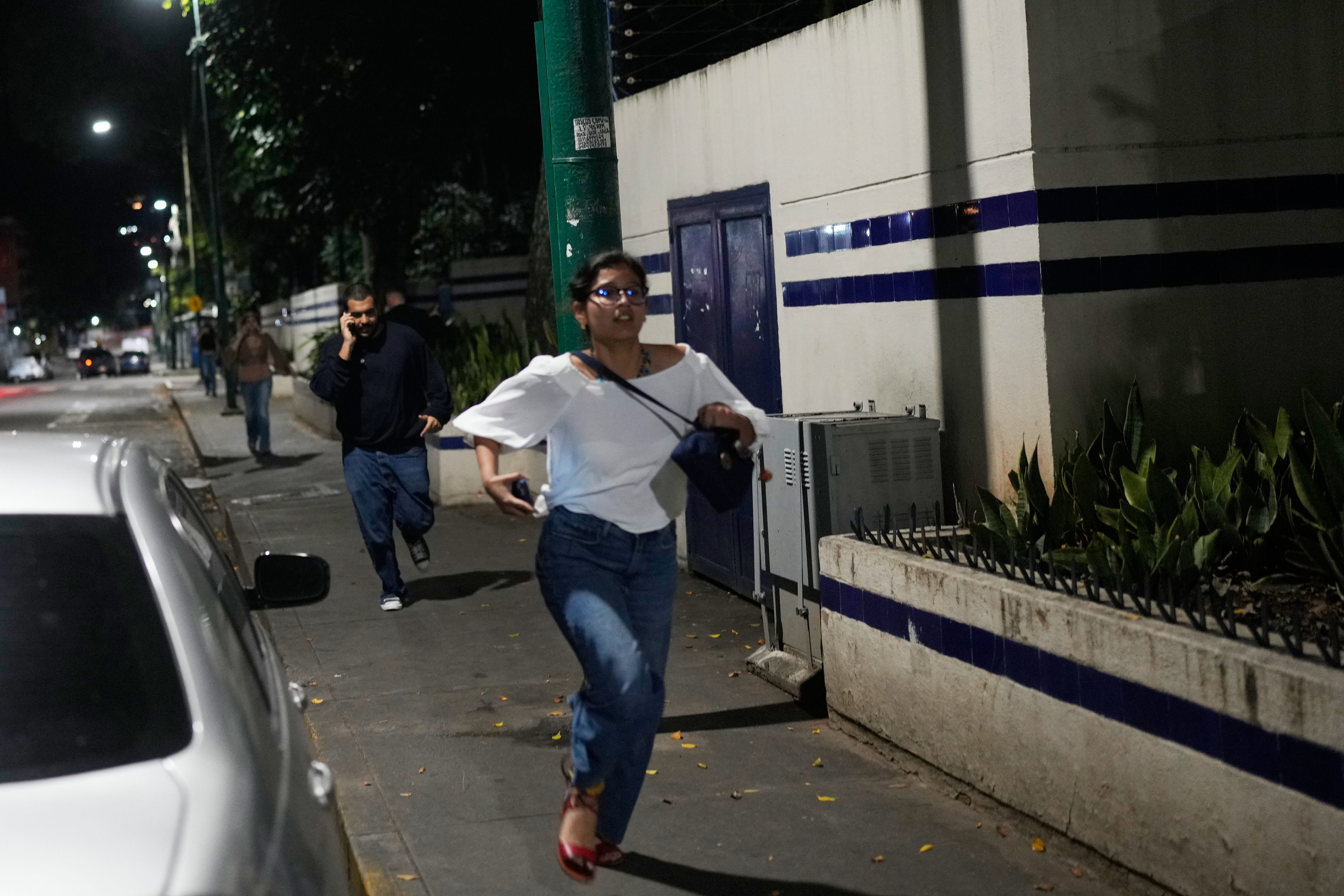
Pedestrians run after explosions and low-flying aircraft were heard in Caracas, Venezuela, Saturday, Jan. 3, 2026. Credit - Matias Delacroix—Associated Press

President Donald Trump said Saturday that the United States had captured Venezuelan President Nicolas Maduro after carrying out a "large-scale" strikeagainst the country.

The extraordinary attack followsmonths of pressurefrom the Trump Administration on Maduro to cede power in the South American country over long-standing accusations of drug trafficking and election rigging.

It represents the largest U.S. military operation in Latin America since the 1989 invasion of Panama, when, as today, the U.S. captured the country's leader, Manuel Antonio Noriega.

The attack is the second major military campaign launched by the president since returning to office a year ago, following widespread airstrikes on Iran's nuclear facilities in June.

In a post on Truth Social, TrumpsaidMaduro and his wife had been "captured and flown out of the Country," adding that the operation "was done in conjunction with U.S. Law Enforcement."

Maduro was indicted on corruption and drug trafficking charges in the U.S. in 2020. The State Department had announced a $50 million reward for information leading to his arrest or conviction.

In an interview with Fox & Friends hours after the operation, Trump gave further details about the raid.

"We were going to do this four days ago, but the weather was not perfect, and then all of a sudden it opened up and we said go. He was in a highly guarded — it was like a fortress actually," he said, adding that no American troops were killed.

Trump also told Fox News the U.S. would be involved in deciding Venezuela's future: "We'll be involved in it very much."

"We can't take a chance in letting somebody else run and just take over what he left, or left off," he said.

Vice President JD Vance said Trump had offered Maduro "multiple off ramps, but was very clear throughout this process: the drug trafficking must stop, and the stolen oil must be returned to the United States."

Attorney General Pam BondisaidMaduro and his wife, Cilia Flores, had been indicted in New York and would "soon face the full wrath of American justice on American soil in American courts."

Read more:Trump Advisors and Venezuela Opposition Leaders Plan for Maduro's Departure

Trump's comments came soon after explosions were reported across Venezuela in the early hours of Saturday morning. Witnesses reported strikes in the capital, Caracas, beginning around 2 am local time. Videos posted to social media showed large explosions and what appeared to be U.S. military aircraft flying low over the city.

Venezuelan ruling party leader Nahum Fernández told The Associated Press that Maduro and his wife were at their home within the Ft. Tiuna military installation when they were captured.

"That's where they bombed," he said. "And, there, they carried out what we could call a kidnapping of the president and the first lady of the country."

The Venezuelan government said attacks also occurred in the states of Miranda, Aragua, and La Guaira. Photographs showed parts of Fuerte Tiuna, Venezuela's largest military complex, engulfed in flames.

In a national address, Venezuela's defense minister Gen. Vladimir Padrino Lopez denounced what he called an "invasion" and a "blatant outrage." The statement was the first response from Maduro's government since the strikes began.

Venezuela's Vice President Delcy Rodriguez, who is next in line to take charge of government, said she did not know the whereabouts of either Maduro or his wife.

"We demand that President Donald Trump's government provide immediate proof of life for President Maduro and the First Lady," Rodriguez said in an audio played on state TV.

Picture of fire at Fuerte Tiuna, Venezuela's largest military complex, after a series of explosions in Caracas on January 3, 2026. Loud explosions, accompanied by sounds resembling aircraft flyovers, were heard in Caracas around 2:00 am (0600 GMT) on January 3, an AFP journalist reported. The explosions come as US President Donald Trump, who has deployed a navy task force to the Caribbean, raised the possibility of ground strikes against Venezuela. <span class=Luis Jaimes— AFP via Getty Images" style="max-width:100%; height:auto; border-radius:6px; margin:10px 0;" loading="lazy" />

President Trump reportedly ordered the strikes inside Venezuela days ago, according to CBS News, after months of threats to expand a U.S. bombing campaign against alleged drug boats to targets inside the country.

Trump has repeatedly called Maduro an illegitimate president and his administration has accused him of running a "narco state", without providing evidence. He said in aninterviewlast month that Maduro's "days are numbered."

Republican U.S. Senator Mike Leesaidthat Secretary of State Marco Rubio had told him Maduro would stand trial on criminal charges in the United States.

"He informed me that Nicolás Maduro has been arrested by U.S. personnel to stand trial on criminal charges in the United States, and that the kinetic action we saw tonight was deployed to protect and defend those executing the arrest warrant," Lee said in a post on X.

He added that Rubio "anticipates no further action in Venezuela now that Maduro is in U.S. custody."

Maduro had earlier declared a state of emergency in response to the attacks, according to a statement from the Venezuelan communications ministry. The statement said the government "rejects, repudiates, and denounces" U.S. military aggression.

Maduro's precise whereabouts are currently unknown.

At least 115 people have been killed since September in the U.S. strikes against alleged boats that the Trump Administration claims are smuggling drugs. Analysts andlegal experts have questionedthe legality of the boat strikes, which have been carried out without congressional approval.

The Trump Administration has been building up military forces in the region for months while ratcheting up threats against Venezuela's government. The Pentagon deployed 10 F-35s to Puerto Rico. The U.S.S. Gerald Ford, thought to be the largest and most advanced aircraft carrier in the world, recently joined eight warships and some 10,000 troops already in the region.

Trump also authorized the Central Intelligence Agency (CIA) to conduct covert operations in Venezuela. Maduro responded directly to the revelation, calling the move a "desperate" attempt at regime change.

A Pentagon spokesperson referred TIME's questions to the White House. The White House directed TIME to President Trump'sposton Truth Social.

Trump said that he would speak at a news conference at 11 a.m. from Mar-a-Lago, where he is currently staying.

This is a developing story.

Contact usatletters@time.com.

Trump Says U.S. Has Captured Venezuela's President Maduro

Pedestrians run after explosions and low-flying aircraft were heard in Caracas, Venezuela, Saturday, Jan. 3, 2026. Credit - Matias Delacroi...


ALPHA MAG © 2015 | Distributed By My Blogger Themes | Designed By Templateism.com