President Donald Trump takes questions as he speaks to the press following military actions in Venezuela, at his Mar-a-Lago residence in Palm Beach, Fla., on Jan. 3, 2026. Credit - Jim Watson—AFP/Getty Images

By early Saturday morning, the United States had taken a step not seen inmore than three decades: capturing a sitting foreign leader and flying him out of the country to face criminal charges in New York.

Read more:How the World Is Reacting to the U.S. Capture of Nicolas Maduro

President Nicolás Maduro of Venezuela and his wife, Cilia Flores, were seized ina pre-dawn raidin Caracas by American special operations forces, the culmination of months of covert intelligence work and steadily escalating military pressure ordered by President Donald Trump to oust the authoritarian leader. The operation, officials said, unfolded in less than half an hour overnight but drew on weeks of rehearsals and a vast armada of aircraft and intelligence assets that tracked Maduro's behavioral habits.

Speaking from Mar-a-Lago on Saturday, Trump praised what he called a "spectacular assault" on several military facilities in the oil-rich nation, adding that no American service members were killed and no U.S. military equipment was lost. "No nation in the world could achieve what America achieved yesterday," he said.

Read more:Trump Signals Long-Term Involvement in Venezuela After Capturing President

Below is how the operation unfolded—and what comes next.

Months of pressure

The raid on Maduro's compound was the endpoint of a strategy Trump began accelerating last fall, after authorizing the C.I.A. to take a more aggressive posture toward Venezuela. The New YorkTimesreportedthat C.I.A. officers working clandestinely inside the country since August built a detailed picture of Maduro's "pattern of life"—where he lived, how he moved, and when he was most vulnerable.

The covert campaign ran in parallel with an increasingly overt show of force. Since September, the Trump Administration has ordered dozens of strikes on boats accused of carrying drugs in the Caribbean and eastern Pacific, killing at least 115 people. In late December, the C.I.A. carried out a drone strike on a Venezuelan dock believed to be used by drug traffickers.

Administration officials said the strikes were intended to take down transnational drug cartels, arguing that Venezuelan territory had become central to trafficking routes into the United States But the campaign also served a broader strategic purpose: degrading Venezuela's ability to detect or respond to American military movements, while signaling to Maduro that Trump was prepared to act directly on Venezuelan soil.

The raid on Maduro's compound

Trump described Maduro as heavily protected inside a presidential compound in Caracas he likened to a fortress. "It had steel doors, it had what they call a safety space where it's solid steel all around," Trump said to reporters on Saturday.

He added that U.S. forces were prepared to cut through those steel walls with blow torches if Maduro locked himself in the safe room, but the Venezuelan leader was unable to close the door in time.

"He was trying to get into it, but he got bum-rushed right so fast that he didn't get into that. We were prepared," Trump continued.

The military had rehearsed the operation using a replica of Maduro's safe house, Trump added, allowing the special forces to break through steel doors in a matter of seconds. "They actually built a house which was identical to the one they went into, with all the same steel all over the place," Trump said.

"I watched it literally like you are watching a television show," he added. "It was an amazing thing."

The operation was carried out by an elite U.S. Army special operations unit known as Delta Force, which specializes in covert and dangerous missions at the direction of the president.

'Good luck and Godspeed'

Trump said the U.S. intended to carry out the operation "four days ago," but that the weather nearly delayed the mission.

"Over the weeks through Christmas and New Year's, the men and women of the United States military sat ready," said General Caine, the chairman of the Joint Chiefs of Staff, waiting for conditions that would minimize civilian harm and maximize surprise.

According to General Caine, the final order to strike Venezuela came late Friday night. "At 10:46 p.m. ET, the President ordered the United States military to move forward with this mission," he said. "He said to us, 'Good luck and Godspeed.'"

Over the next several hours, more than 150 aircraft—including bombers, fighter jets, surveillance planes, helicopters and drones—launched from 20 bases on land and at sea across the Western Hemisphere. Thousands of flight hours were airborne at once, General Caine said, in an operation he called "audacious" and "unprecedented" in its complexity.

The helicopters carrying the apprehension force, which included U.S. law enforcement officers, skimmed toward Venezuela at roughly 100 feet above the water to avoid detection. As they approached the coast, U.S. Cyber Command, Space Command and other agencies layered effects overhead to protect the aircraft and preserve surprise, General Caine said.

Trump said American forces shut down much of Caracas's power during the operation. "It was dark," he said. "The lights of Caracas were largely turned off due to a certain expertise that we have."

As helicopters neared the city, U.S. aircraft disabled Venezuelan air defense systems to clear a path. By 1:01 a.m. Eastern time—2:01 a.m. in Caracas—the helicopters arrived at Maduro's compound.

A firefight during the raid

General Caine said that as the apprehension force descended and moved to isolate the area, helicopters came under fire, prompting American forces to respond "with overwhelming force and self defense."

One U.S. aircraft was hit but remained flyable, and all aircraft returned safely, he added.

On the ground, intelligence teams provided real-time updates, allowing the force to navigate the compound and avoid unnecessary risk. Maduro and Flores, both indicted in the United States on narco-terrorism conspiracy charges, surrendered and were taken into custody without any American loss of life.

"A couple of guys were hit," Trump said, referring to U.S. service members who were injured. "But they came back and they're supposed to be in pretty good shape."

The entire assault lasted less than 30 minutes, though explosions and low-flying aircraft sent shock waves through Caracas. It is currently unclear how many members of the Venezuelan military were killed.

After securing the couple, U.S. forces called in helicopters to extract the team while fighter jets and drones provided overhead cover. By 3:29 a.m. Eastern time, General Caine said, the helicopters were back over open water with Maduro and Flores on board. They were later transferred to the U.S.S. Iwo Jima, where Trump said they were held en-route to New York.

On Saturday morning, Trump posted on his Truth Social account a photo of Maduro blindfolded and in a sweatsuit aboard the ship.
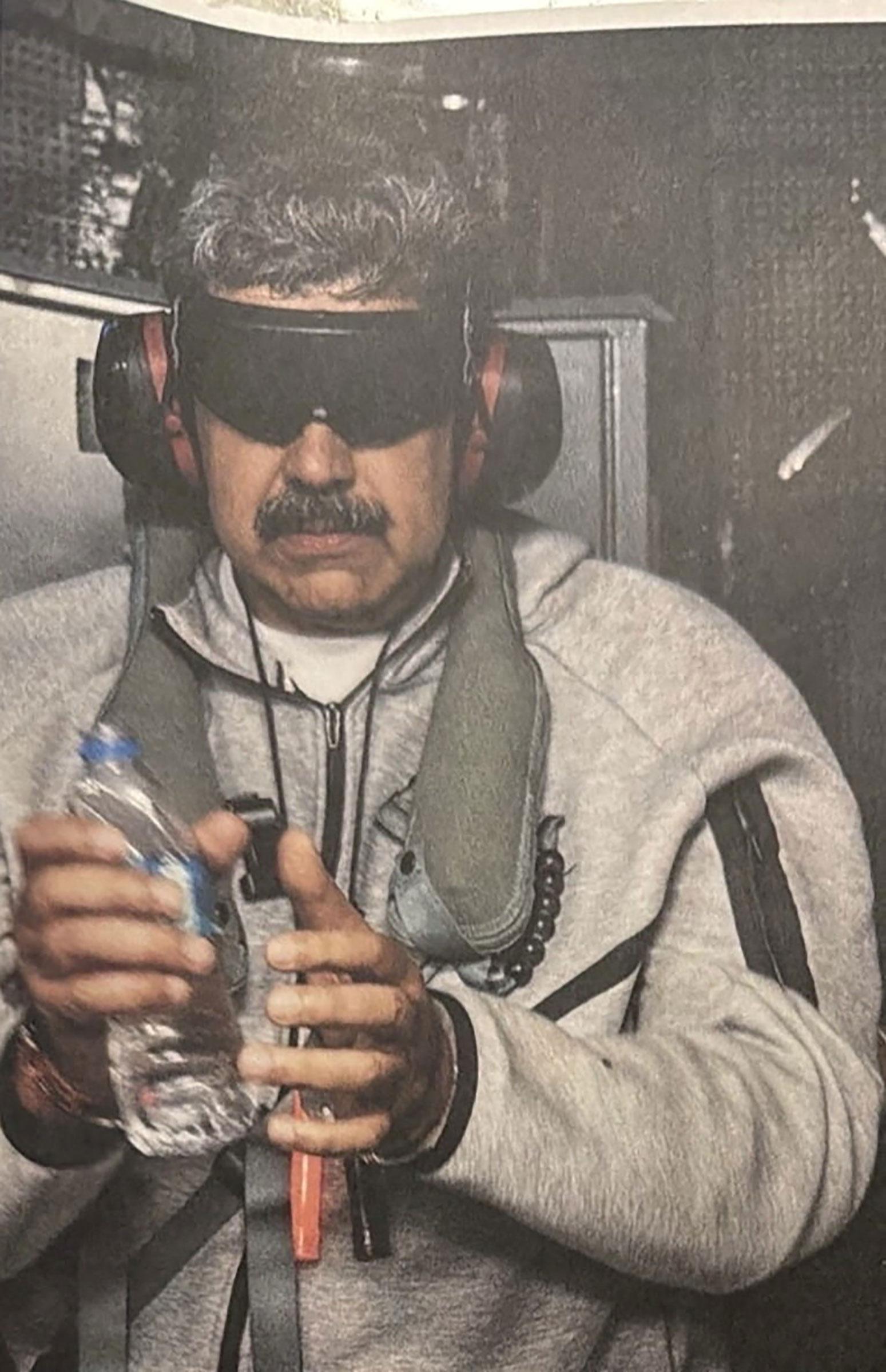
A photograph which President Donald Trump posted on his Truth Social account shows what he describes as Venezuelan President @realDonaldTrump/Handout/Reuters" style="max-width:100%; height:auto; border-radius:6px; margin:10px 0;" loading="lazy" />

Why Trump authorized the operation

Trump framed the raid as both a law enforcement action and an act of war against drug trafficking networks he says are protected by the Venezuelan state.

"We had to do it because it's a war," he said, citing what he described as an armed conflict with cartels moving drugs toward the United States.

The Justice Department unsealed a new indictment on Saturday accusing Maduro and Flores of participating in a narco-terrorism conspiracy. Attorney General Pam Bondi said the couple would soon face justice "on American soil in American courts."

Still, the legal authority for the strike remains contested. Congressional leaders said the administration had not notified the Armed Services Committees in advance, and some lawmakers questioned whether the President could authorize such an operation without explicit approval from Congress.

Trump said the United States planned to oversee Venezuela until a transition of power could be arranged. "We're going to run the country until such time as we can do a safe, proper and judicious transition," he said.

Write toNik Popli atnik.popli@time.com.

How The U.S. Captured Venezuelan Leader Nicolas Maduro

President Donald Trump takes questions as he speaks to the press following military actions in Venezuela, at his Mar-a-Lago residence in Pa...
FACT FOCUS: Trump repeats false claims as he discusses US raid to extract Venezuela's president

President Donald Trump on Saturday held an extended news conference to explain theU.S. raid on Venezuelato extract President Nicolás Maduro and his wife, at times veering off topic and repeating false claims around his initiatives.

In praising the military, Trump highlighted National Guard deployments into U.S. cities, making erroneous claims about crime in Washington, D.C., Chicago and Los Angeles.

Here's a closer look at the facts.

TRUMP, discussing the impact of U.S. strikes on boats allegedly carrying drugs from Venezuela: "Each boat kills on average, 25,000 people."

THE FACTS: Trump has previously made this claim suggesting that 25,000 American lives are saved with every alleged drug boat U.S strikes "take out." But the numbers don't add up and sometimes don't exist. For example, people in the U.S. who die from drug overdoses each year are far fewer than the number of people Trump suggests have been saved by the boat strikes his administration has carried out since September.

According to thelatest preliminary datafrom the Centers of Disease Control and Prevention's National Vital Statistics System, there were up to 76,516 drug overdose deaths in the U.S. during the 12-month period that ended in April 2025, down 24.5% from the up to 101,363 for the previous 12-month period.

The U.S. military has attackedat least 35 boatsin the Caribbean Sea and eastern Pacific Ocean since strikes began on Sept. 2, most recently on Dec. 31. Using Trump's numbers, that would mean the strikes have prevented 875,000 fatal drug overdoses in the U.S — far more than the number of overdose deaths that have occurred in recent 12-month periods. This essentially implies that the administration is saving more lives than would have ever been lost.

Opioids accounted for 73.4% of drug overdose deaths in 2024,according to the CDC's State Unintentional Drug Overdose Reporting System. That includes 65.1% from illegally made fentanyls. But while the boat strikes have targeted vessels largely in the Caribbean Sea, fentanyl is typically trafficked to the U.S.overland from Mexico, where it is produced with chemicals imported from China and India.

TRUMP, discussing the National Guard deployment in Washington, D.C.: "We haven't had a killing. We had the terrorist attack a few weeks ago, a little bit of a different kind of threat. But we haven't had a killing in a long period of time. Six, seven months."

THE FACTS: Trump has alsomade this false claimbefore. There have been59 homicidesin the past seven months, including two last week, according to the latest Metropolitan Police Department statistics.

That number also includes thefatal shootingof a West Virginia National Guard member on Nov. 26 by an Afghan national. Another Guard member was injured in the shooting, which FBI Director Kash Patel said was being investigated as anact of terrorism.

The city saw126 homicidesin 2025, 29 of whichoccurred afterNational Guard troops were deployed to the nation's capital on Aug. 11.

In launching the deployment, Trumpdeclared a public safety emergencyand said his administration also would be removing homeless encampments. He said he aimed to reduce crime, but the city's attorney general said violent crime in the district reached 30-year lows in 2024 and was down an additional 26% in 2025.

TRUMP, discussing National Guard deployments in Chicago and Los Angeles: "We also helped, as you know, in Chicago. Then crime went down a little bit there ... And likewise, Los Angeles, where — we saved Los Angeles early on."

THE FACTS: Guard members were never on the streetsin Chicagoas legal challenges played out. When the Chicago deployment was challenged in court, a Justice Department lawyer said the Guard's mission would be to protect federal properties and government agents in the field, not "solving all of crime in Chicago."

Between 2020 and 2024, homicides in Chicago were down 25%. However, rape increased 27%, while robbery went up 17% and aggravated assault up 11%.

Trump deployed about 4,000 National Guard members and 700 Marines to Los Angeles in June to guard federal buildings and, later, to protect federal agents as they carried out immigration arrests.

The number of troops slowly dwindled until just several hundred were left. They were removed from the streets by Dec. 15 after a lower court ruling that also ordered control to be returned to Gov. Gavin Newsom. But an appeals court had paused the second part of the order, meaning control remained with Trump. In a Tuesday court filing, the Trump administration said it was no longer seeking a pause in that part of the order.

The U.S. Court of Appeals for the Ninth Circuit on Wednesday ordered the Trump administration to return control of the National Guard to Newsom.

Find AP Fact Checks here:https://apnews.com/APFactCheck.

FACT FOCUS: Trump repeats false claims as he discusses US raid to extract Venezuela's president

President Donald Trump on Saturday held an extended news conference to explain theU.S. raid on Venezuelato extract Presid...

FILE - President Nicolas Maduro, accompanied by first lady Cilia Flores, greets supporters during an event marking the anniversary of a 1958 coup ousting dictator Marcos Pérez Jiménez, in Caracas, Venezuela, Jan. 23, 2024. Credit - Jesus Vargas—Associated Press

World leaders reacted to thecapture of Venezuelan President Nicolas Maduroby the United States with a mixture of outrage, concern, and caution on Saturday.

President Donald Trump announced the capture of Maduro and his wife, Cilia Flores, and a "large-scale" strike against Venezuela hours after explosions were reported in the country's capital, Caracas.

The extraordinary attack followsmonths of pressurefrom the Trump Administration on Maduro to cede power in the South American country over long-standing accusations of drug trafficking and election rigging.

Read more:Venezuela Isn't Panama—No Matter How Much Trump Wishes It Were

It represents the largest U.S. military operation in Latin America since the 1989 invasion of Panama, when, as today, the U.S. captured the country's leader, Manuel Antonio Noriega.

Many countries expressed outrage over the capture of Maduro on Saturday, while even some U.S. allies issued statements calling for the rule of law to be respected.

South American leaders in particular expressed anger at the attack.

Here is a round-up of global reaction to the operation.

United Kingdom

British Prime Minister Keir Starmer said he wanted to speak to President Trump before making any firm statements either way about Maduro's capture.

"I always say and believe we should uphold international law, but I think at this stage [in a] fast moving situation, let's establish the facts and take it from there," he said in a statement to British broadcasters.

"I want to establish the facts first. I want to speak to President Trump," he said. "I want to speak to allies. As I say I can be absolutely clear we were not involved in that."

Russia

Russia's Foreign Ministry said it is "extremely alarmed" and called for "immediate clarification", according to a statement posted on Saturday on the ministry's Telegram channel.

It added later in a post on X: "The US committed an act of armed aggression against Venezuela, which gives rise to deep concern & warrants condemnation."

"The pretexts used to justify these actions are untenable. Russia reaffirms its solidarity with the Venezuelan people,' it continued in the post.

China

China's Foreign Ministry said in a statement that it was "deeply shocked" by what it described as a "blatant use of force against a sovereign state and action against its president."

"Such hegemonic acts of the U.S. seriously violate international law and Venezuela's sovereignty and threaten peace and security in Latin America and the Caribbean region," it said.

"China firmly opposes it. We call on the U.S. to abide by international law and the purposes and principles of the UN Charter, and stop violating other countries' sovereignty and security," the statement continued.

United Nations

The United Nations said it was "deeply alarmed" by the U.S. strikes and capture of Maduro, suggesting it could have violated international law.

"These developments constitute a dangerous precedent," Stéphane Dujarric, spokesman for the U.N. secretary-general, said in a statement.

"The Secretary-General is deeply alarmed by the recent escalation in Venezuela, culminating with today's United States military action in the country, which has potential worrying implications for the region," she added.

"The Secretary-General continues to emphasize the importance of full respect—by all—of international law, including the U.N. Charter. He's deeply concerned that the rules of international law have not been respected," the statement continued

European Union

EU foreign policy chief Kaja Kallas wrote on X that she had spoken to US Secretary of State Marco Rubio and the EU ambassador in Caracas.

"The EU has repeatedly stated that Mr Maduro lacks legitimacy and has defended a peaceful transition," she wrote. "Under all circumstances, the principles of international law and the UN Charter must be respected. We call for restraint."

Mexico

In a statement on X, Mexico's President, Claudia Sheinbaum, shared an excerpt from the United Nations Charter.

"The Members of the Organization, in their international relations, shall refrain from the threat or use of force against the territorial integrity or political independence of any State, or in any other manner inconsistent with the Purposes of the United Nations."

Brazil

Brazilian President Luiz Inacio Lula da Silva condemned the capture of Maduro as crossing "an unacceptable line".

"Attacking countries, in flagrant violation of international law, is the first step toward a world of violence, chaos, and instability, where the law of the strongest prevails over multilateralism," Lulawrote on X.

"The international community, through the United Nations, needs to respond vigorously to this episode," he added.

Colombia

Colombia's President Gustavo Petro condemned the U.S. operation in several posts on X.

"The Government of Colombia rejects the aggression against the sovereignty of Venezuela and of Latin America," hewrote.

"Internal conflicts between peoples are resolved by those same peoples in peace. That is the principle of the self-determination of peoples, which forms the foundation of the United Nations system," Petro continued.

Denmark

Denmark, which has been on the receiving end of threats from the Trump Administration to take control of Greenland, issued a muted response to the operation.

"Dramatic development in Venezuela, which we are following closely. We need to get back on track toward de-escalation and dialogue. International law must be respected," Foreign Minister Lars Løkke Rasmussenwrote on X.

Spain

Spanish Prime Minister Pedro Sanchez called for "de-escalation and responsibility."

"International Law and the principles of the United Nations Charter must be respected," Mr Sanchezwrote on X.

Contact usatletters@time.com.

How the World Is Reacting to the U.S. Capture of Nicolas Maduro

FILE - President Nicolas Maduro, accompanied by first lady Cilia Flores, greets supporters during an event marking the anniversary of a 195...
Anthony Joshua returns to Britain after car crash that killed two friends in Nigeria

LONDON (AP) — Former world heavyweight championAnthony Joshuahas reportedly flown back to Britain several days after afatal car crashthat killed two of his friends in Nigeria.

Sina Ghami and Latif "Latz" Ayodele died after the vehicle they were traveling in along with Joshua struck a stationary truck on a major road near Lagos on Monday.

Joshua sustained minor injuries and the two-time heavyweight champion was released from a hospital on Wednesday after being deemed clinically fit to recuperate at home.

British media reported on Saturday that Joshua has returned home ahead of the funerals of Ghami and Ayodele.

Ghami was Joshua's strength and conditioning coach while Ayodele was a trainer. Just hours before the crash, Joshua and Ayodele posted clips on social media playing table tennis together.

The driver of the car, Adeniyi Mobolaji Kayode,was chargedon Friday with dangerous and reckless driving, with the court case adjourned to Jan. 20 for trial.

Joshua has family roots in Nigeria and he briefly attended boarding school there as a child. He also holds Nigerian nationality.

AP sports:https://apnews.com/sports

Anthony Joshua returns to Britain after car crash that killed two friends in Nigeria

LONDON (AP) — Former world heavyweight championAnthony Joshuahas reportedly flown back to Britain several days after afat...
Rory McIlroy on Brooks Koepka in TGL: '(I) would love him to play'

Rory McIlroy said he has no qualms about the prospect of Brooks Koepka joining TGL.

And McIlroy's voice likely holds some water given that he is a co-founder of the indoor golf simulation league along with Tiger Woods.

As for Koepka, he has newfound availability following his departure from LIV Golf, the upstart circuit where he has played for the last three years. LIV announced on Dec. 23 that Koepka would be leaving the league because he was "prioritizing the needs of his family."

So would Koepka be welcome in TGL?

"I would say that's up to people that are more powerful and more important than me. But I am one of the founders. I would love him to play," McIlroy said on Friday after his Boston Common Golf team recorded a 7-5 win over Los Angeles Golf Club.

"If there's space on a team for Brooks to come and play, it only makes what we're trying to do stronger. He's a five-time major champion. He's been one of the best players of our generation. If he decides it's something that he wants to do, I'm sure we'll find a way to include him."

McIlroy's comments came on the heels of his appearance on "The Overlap" podcast earlier on Friday. He said on the podcast that he wouldn't object to LIV stars joining the PGA Tour.

"I think they've already paid their consequence. They've made the money but they've paid their consequence in terms of the reputation and some of the things they've lost by going over there," McIlroy said. "If it made the overall tour stronger to have Bryson DeChambeau back and whoever else, I would be OK with it.

"But it's not just me, and I recognize that not everyone is in my position. It would be up to the collective group of PGA Tour members to make that decision."

--Field Level Media

Rory McIlroy on Brooks Koepka in TGL: '(I) would love him to play'

Rory McIlroy said he has no qualms about the prospect of Brooks Koepka joining TGL. And McIlroy's vo...


ALPHA MAG © 2015 | Distributed By My Blogger Themes | Designed By Templateism.com