Blue Jays finally land a Japanese star with Kazuma Okamoto — but where does he fit on the roster?

The defending American League champion Toronto Blue Jays, having already spent more in free agency than any other major-league club, have made another big splash to start the new year,signing 29-year-old Japanese slugger Kazuma Okamoto to a reported four-year, $60 million deal.

Just weeks after their crushing Game 7 defeat to the Dodgers in the World Series, it was the Blue Jays who executed the first big move of the offseason by signing right-hander Dylan Cease to a seven-year, $210 million deal, an enormous commitment that still stands as the largest contract given to a free agent this winter. That turned out to be just the start of Toronto's efforts to strengthen its pitching staff, as two more considerable deals followed in December, with another starter in Cody Ponce (3 years, $30M) and one of the top relievers available in Tyler Rogers (3 years, $37M).

But for all Toronto accomplished early in the offseason on the mound, monumental questions remained about its plans to fill out its position-player group, particularly in the wake of homegrown star Bo Bichette reaching free agency. Such speculation was driven by not only the question of whether the Blue Jays would retain Bichette but also the franchise's newfound status as one of the league's biggest spenders, making them potential suitors forseveral of the top free-agent bats on the market. That includes the top position player available, outfielder Kyle Tucker, whoreportedly paid a visitto Toronto's spring training complex in Dunedin in early December, andanother premium infielderin Alex Bregman, whose decision will massively impact the division-rival Red Sox.

Meanwhile, the signing deadlines mandated by the 45-day posting windows for the top Japanese free agents drew closer, offering a deadline to spur some action on the free-agent market. As it turned out, the teams involved in the pursuit of these three NPB stars — slugger Munetaka Murakami, right-handed pitcher Tatsuya Imai and, finally, Okamoto — remained uncertain until the very end of their posting processes. The rebuilding White Sox stunned first by landing Murakami on a two-year deal. Then the contending Astrosswooped in to sign Imai on a similar short-term pact. As Okamoto's deadline neared, reports consistently identified the Padres, Angels and Pirates as most involved in his market, but based on the opaque nature of the previous two postings, it seemed only right that a mystery team would surface at the final hour for Okamoto.

Sure enough, the Blue Jays emerged as that mystery team, securing a fascinating addition that raises further questions about the club's offseason strategy. At first glance, before contemplating his exact role on the roster, Okamoto is a natural fit for Toronto asan advanced hitter who has paired strong contact skills and power production throughout his illustrious NPB career. He's the style of slugger that Guerrero and Bichette have long embodied for Toronto and that helped define the club's surge to the 2025 division title and a magical run through October. That Toronto, amidst its search for offensive reinforcements, would be attracted to Okamoto as a player comes as no surprise.

But how exactly Okamoto fits on Toronto's roster is a challenging question to answer, considering how much unfinished business the Blue Jays seem to have this winter, not to mention the position players already on the roster. Team context aside, most evaluators consider Okamoto viable at third base, though unlikely to be a plus defender at the hot corner at the major-league level and likely profiling better at first base long-term. Okamoto also has some experience in the outfield, having made 68 starts in left over the course of his NPB career.

[Get more Toronto news: Blue Jays team feed]

For the Blue Jays, the obvious place to begin is acknowledging that even if scouts view first base as Okamoto's ideal spot on the diamond, that will not be an option for him anytime soon; Guerrero's presence means first base in Toronto is about as spoken for as any single position in the entire league. It's also worth noting that at-bats might be hard to come by at DH — at least in 2026 — with veteran star George Springer under contract for one more year and Toronto surely preferring to limit his exposure to the outfield as he enters his age 36-season.

As such, the only logical conclusion at this stage is that Toronto is comfortable with Okamoto at third base, and a realistic path to playing time in the outfield exists as well. For the 2025 Jays, third base was largely occupied by Addison Barger and Ernie Clement, with Clement earning the bulk of the reps in the postseason. Both players shined in October, affirming that they could be core pieces of the Jays' offense moving forward. Each player has also demonstrated defensive versatility, with Clement capable of bouncing around the infield and Barger's rocket arm and athleticism proving ultra-valuable in right field.

That flexibility should open the door for Okamoto to be the primary third baseman, with Barger spending more time in right and Clement perhaps moving to second base in the event that Bichette departs (with Andres Gimenez sliding to shortstop). There could also be at-bats available in the outfield for Okamoto, perhaps as a right-handed complement to Nathan Lukes in one of the corner spots. How the switch-hitting Anthony Santander — entering his second year as a Blue Jay after a total failure of an introductory campaign — fits into the equation is another worthwhile question at this juncture, particularly if Toronto pursues another outfield addition such as Tucker.

The addition of Okamoto would seem to take Toronto out of the market for Bregman, but a reunion with Bichette could still be in store, as could an agreement with Tucker, thanks in large part to the versatility of some of the incumbent position players — and as a response to some of those players' weaknesses. However it shakes out, it's clear that Toronto valued Okamoto highly enough to bring him into the fold and figure the rest out later. That's a refreshing strategy in an era when so many risk-averse teams are acting with extreme caution at this time of year.

And while his fit on the roster remains to be seen, Okamoto joining Toronto is unquestionably an enormous organizational victory for the Blue Jays following their ill-fated pursuits of Shohei Ohtani and Roki Sasaki the past two offseasons. Toronto has not been shy about its intentions to expand its footprint internationally, and adding a player who starred for the Yomiuri Giants, one of the most prominent and historically successful teams in NPB, is a solid step in that direction. While there have been a few Japanese players to appear for the Blue Jays over the years, including affable utilityman Munenori Kawasaki and left-handed pitcher Yusei Kikuchi, just once in the franchise's history has it signed a player directly from NPB: right-handed pitcher Shun Yamaguchi, whose transition to MLB was upended by the pandemic, making his lone season in 2020 particularly challenging.

— Toronto Blue Jays (@BlueJays)January 3, 2026

More broadly, and however Toronto proceeds from here, adding Okamoto is a bold reminder of the Blue Jays' fresh status as one of baseball's certified behemoths. Cease's deal alone makes Toronto the top spender in free agency this winter, but remove his megadeal completely, and the Blue Jays' combined commitments to Cease, Rogers and Okamoto ($127M) stillplace them third in MLBin free-agent spending, behind Baltimore and Philadelphia, the only two other teams to hand out nine-figure contracts this winter.

All together, it's a remarkable display of aggression and urgency in the wake of the franchise's devastating near-miss at a championship, and it's a welcome follow-up in financial investment after the $500 million extension bestowed on the face of the franchise in April.

A punchline in previous offseasons after coming up short in pursuit of top free agents, the Blue Jays have definitively flipped the narrative. Adjust your expectations accordingly — because Toronto might just have another splash (or two) coming before Opening Day.

Blue Jays finally land a Japanese star with Kazuma Okamoto — but where does he fit on the roster?

The defending American League champion Toronto Blue Jays, having already spent more in free agency than any other major-l...
Notre Dame coach Micah Shrewsberry watches from the sideline during the first half of the team's NCAA college basketball game against Duke on Saturday, Jan. 6, 2024, in South Bend, Ind. (AP Photo/Michael Caterina)

A disputed call near the end of his team's 72-71 loss at Cal on Friday night caused Notre Dame men's basketball coach Micah Shrewsberry to lose his composure.

Shrewsberry charged off the floor in pursuit of referee Adam Flore as soon as the final horn sounded. Multiple players and staffers had to restrain Shrewsberry as the third-year Notre Dame coach continued to shout at Flore and point in his direction.

Another angle of Notre Dame HC Micah Shrewsberry chasing a ref after the loss to Cal:https://t.co/L7EwQoMHUrpic.twitter.com/SteSpRBFAZ

— Joaquin Ruiz (@WalkingRuiz)January 3, 2026

Flore became the target of Shrewsberry's rage when he controversially awarded Cal the chance for a go-ahead four-point play in the final seconds.

With Notre Dame leading by three and 9.9 seconds to play, Shrewsberry instructed the Fighting Irish to foul before Cal could attempt a game-tying 3-pointer. Notre Dame guard Logan Imes twice swiped at Cal guard Dai Dai Ames as he crossed mid-court but no foul was called. The third time, Imes got the timing wrong, reaching at Ames just before he rose and buried a 3-pointer from the left wing.

Flore initially ruled it an and-1 opportunity. Then the referees overturned that call and said the foul occurred before the shot. Then the referees huddled together once more and reversed the call a second time, deeming the basket good and sending Ames to the foul line to attempt the go-ahead free throw with 5.5 seconds remaining.

This is what prompted it: A foul on Logan Imes, ruled to be in the act of shooting.Notre Dame was trying to foul up three. The officials called this a shooting foul, reversed it and then reversed it back.pic.twitter.com/qkWGPcvqi9

— Jack Soble (@jacksoble56)January 3, 2026

"I thought there was a foul going up," Cal coach Mark Madsen told reporters after the game. "I saw the official signal it. They conversed a couple times and they allowed it. There's so much emotion in that gym, for the officials, for me, for the other team. I was grateful Dai Dai rose up and made the shot and I was grateful Dai Dai had the maturity and the huge presence of mind and the composure to knock down the free throw."

After Ames sank the go-ahead foul shot, Notre Dame had one final chance to win, but Braedon Shrewsberry's 3-point attempt clanked off the front rim.

In a statement released Saturday morning, Micah Shrewsberry apologized for his behavior after the final buzzer, calling his actions "inappropriate and not symbolic of the leader I strive to be and what Notre Dame expects of its coaches and educators."

"I will learn from this lack of judgement and be better in the future," he added.

A Statement from Head Coach Micah Shrewsberry:"I want to apologize for what took place immediately after the Cal game last night. My actions were inappropriate and not symbolic of the leader I strive to be and what Notre Dame expects of its coaches and educators. I will learn…

— Notre Dame Men's Basketball (@NDmbb)January 3, 2026

Shrewsberry apparently will avoid suspension for his postgame actions. The ACC called the matter closed on Saturday after publicly reprimanding Shrewsberry for violating the league's sportsmanship policy.

"Shrewsberry aggressively confronted a member of the officiating crew following the game," the ACC's statement said. "The unsportsmanlike behavior that was displayed is unacceptable and tarnishes the on-court play between these institutions."

Notre Dame coach Micah Shrewsberry charges at official after controversial call

A disputed call near the end of his team's 72-71 loss at Cal on Friday night caused Notre Dame men's basketball coach Micah Shrewsb...
When do the NFL playoffs begin? Start date, postseason format, bracket

Super Bowl 60 is just over a month away. Twelve of the 14 spots in theplayoff brackethave been secured and two more will join the race in Week 18. Those franchises will have a chance to etch their name in football lore in Santa Clara in February.

The wild-card round of the 2025 NFL playoffs is set to kick off just one week after the regular season wraps up. The No. 1 seed in each conference will have a bye week but six teams from each conference will play during the first round of the postseason.

Entering Saturday of Week 18, neither 1-seed has been clinched and that highly coveted first-round bye remains up for grabs, leaving the schedule for the top contenders still up in the air.

Here's what to know about the NFL playoffs, including the start date, format and current matchups if the season ended today:

<p style=Week 1: Detroit Lions wide receiver Isaac TeSlaa (18) makes a catch for a touchdown against the Green Bay Packers during the fourth quarter at Lambeau Field. The play was originally ruled an incomplete pass, but the call was overturned. Despite TeSlaa's effort, the Packers won the game 27-13.

" style="max-width:100%; height:auto; border-radius:6px; margin:10px 0;" loading="lazy" /> Week 1: The New England Patriots' Robert Spillane (14) and Christian Elliss (53) tackle Las Vegas Raiders tight end Michael Mayer (87) during the second half at Gillette Stadium. The Raiders won the game, 20-13. Week 1: New York Giants quarterback Russell Wilson (3) fumbles the ball on a tackle by Washington Commanders safety Will Harris (3) during the first quarter at Northwest Stadium. It was a rough Giants debut for Wilson (17 of 37 passing for 168 yards) as the Commanders won the game, 21-6. Week 1: Fireworks go off before the NFL Kickoff Game between the Philadelphia Eagles and Dallas Cowboys at Lincoln Financial Field. The defending Super Bowl champion Eagles opened the season with a 24-20 victory over their longtime NFC East rivals.

Best images of the 2025 NFL season

Week 1: Detroit Lions wide receiver Isaac TeSlaa (18)makes a catch for a touchdownagainst the Green Bay Packers during the fourth quarter at Lambeau Field. The play was originally ruled an incomplete pass, but the call was overturned. Despite TeSlaa's effort, the Packers won the game 27-13.

When do the NFL playoffs start?

The first round of the NFL playoffs will take place from Jan. 10-12.

The wild-card round kicks off the playoffs, with the No. 2 seed through the No. 7 seeds facing off in six matchups in their respective conferences over three days. The first two games will be on Saturday, Jan. 10. A trio of games will take place on Sunday, Jan. 11, and the final game will be on Monday, Jan. 12.

The divisional round of the playoffs will happen one week later, on Saturday, Jan. 17, and Sunday, Jan. 18.

The conference championships will take place the following Sunday. The winners will have a week off before Super Bowl 60 on Feb. 8.

NFL POWER RANKINGS:Another close battle for No. 1 spot in Week 17

NFL postseason format, explained

The NFL's playoff bracket is dynamic, meaning teams are not locked into predetermined future matchups once their seeding is determined.

Each conference will have seven playoff teams: four division winners (No. 1 through No. 4) and three wild card teams (No. 5 through No. 7). The division winners are ranked by best record to worst and will each host at least one playoff game.

In the first round, the No. 1 seed from each conference receives a bye into the division round as the remaining teams – seeds Nos. 2-7 – play for a chance to move on. The team seeded higher in each playoff matchup hosts that contest until the Super Bowl.

After the wild-card round, each No. 1 seed will play the lowest remaining seed in its conference during the divisional round.

At the same time, the second-highest seed will face the second-lowest seed. This setup ensures that the No. 2 and No. 3 seeds cannot meet the No. 1 seed until the conference championship. They will either be knocked out in the wild-card round or play against each other or a lower seed in the divisional round, depending on any upsets.

The winners of the two divisional round games will move on to the conference championships, which will take place on Sunday, January 25.

The conference champions will have a week off before heading to Santa Clara to play in Super Bowl 60 on Sunday, Feb. 8.

NFL playoff bracket

These are the current wild-card matchups, given the state of the playoff picture.

This bracket is subject to change pending the results in Week 18:

AFCwild card

  • No. 2 New England Patriots (13-3, AFC East winners) vs. No. 7 Buffalo Bills (11-5, wild card No. 3)

  • No. 3 Jacksonville Jaguars (12-4, AFC South leaders) vs. No. 6 Los Angeles Chargers (11-5, wild card No. 2)

  • No. 4 Pittsburgh Steelers (9-7, AFC North leaders) vs. No. 5 Houston Texans (11-5, wild card No. 1)

NFC wild card

  • No. 2 Chicago Bears (11-5, NFC North winners) vs. No. 7 Green Bay Packers (9-6-1, wild card No. 3)

  • No. 3 Philadelphia Eagles (11-5, NFC East winners) vs. No. 6 Los Angeles Rams (11-4, wild card No. 2)

  • No. 4 Carolina Panthers (8-8, NFC South leaders) vs. No. 5 San Francisco 49ers (12-4, wild card No. 1)

This article originally appeared on USA TODAY:When do the NFL playoffs start? Format, matchups

When do the NFL playoffs begin? Start date, postseason format, bracket

Super Bowl 60 is just over a month away. Twelve of the 14 spots in theplayoff brackethave been secured and two more will ...

President Donald Trump takes questions as he speaks to the press following military actions in Venezuela, at his Mar-a-Lago residence in Palm Beach, Fla., on Jan. 3, 2026. Credit - Jim Watson—AFP/Getty Images

By early Saturday morning, the United States had taken a step not seen inmore than three decades: capturing a sitting foreign leader and flying him out of the country to face criminal charges in New York.

Read more:How the World Is Reacting to the U.S. Capture of Nicolas Maduro

President Nicolás Maduro of Venezuela and his wife, Cilia Flores, were seized ina pre-dawn raidin Caracas by American special operations forces, the culmination of months of covert intelligence work and steadily escalating military pressure ordered by President Donald Trump to oust the authoritarian leader. The operation, officials said, unfolded in less than half an hour overnight but drew on weeks of rehearsals and a vast armada of aircraft and intelligence assets that tracked Maduro's behavioral habits.

Speaking from Mar-a-Lago on Saturday, Trump praised what he called a "spectacular assault" on several military facilities in the oil-rich nation, adding that no American service members were killed and no U.S. military equipment was lost. "No nation in the world could achieve what America achieved yesterday," he said.

Read more:Trump Signals Long-Term Involvement in Venezuela After Capturing President

Below is how the operation unfolded—and what comes next.

Months of pressure

The raid on Maduro's compound was the endpoint of a strategy Trump began accelerating last fall, after authorizing the C.I.A. to take a more aggressive posture toward Venezuela. The New YorkTimesreportedthat C.I.A. officers working clandestinely inside the country since August built a detailed picture of Maduro's "pattern of life"—where he lived, how he moved, and when he was most vulnerable.

The covert campaign ran in parallel with an increasingly overt show of force. Since September, the Trump Administration has ordered dozens of strikes on boats accused of carrying drugs in the Caribbean and eastern Pacific, killing at least 115 people. In late December, the C.I.A. carried out a drone strike on a Venezuelan dock believed to be used by drug traffickers.

Administration officials said the strikes were intended to take down transnational drug cartels, arguing that Venezuelan territory had become central to trafficking routes into the United States But the campaign also served a broader strategic purpose: degrading Venezuela's ability to detect or respond to American military movements, while signaling to Maduro that Trump was prepared to act directly on Venezuelan soil.

The raid on Maduro's compound

Trump described Maduro as heavily protected inside a presidential compound in Caracas he likened to a fortress. "It had steel doors, it had what they call a safety space where it's solid steel all around," Trump said to reporters on Saturday.

He added that U.S. forces were prepared to cut through those steel walls with blow torches if Maduro locked himself in the safe room, but the Venezuelan leader was unable to close the door in time.

"He was trying to get into it, but he got bum-rushed right so fast that he didn't get into that. We were prepared," Trump continued.

The military had rehearsed the operation using a replica of Maduro's safe house, Trump added, allowing the special forces to break through steel doors in a matter of seconds. "They actually built a house which was identical to the one they went into, with all the same steel all over the place," Trump said.

"I watched it literally like you are watching a television show," he added. "It was an amazing thing."

The operation was carried out by an elite U.S. Army special operations unit known as Delta Force, which specializes in covert and dangerous missions at the direction of the president.

'Good luck and Godspeed'

Trump said the U.S. intended to carry out the operation "four days ago," but that the weather nearly delayed the mission.

"Over the weeks through Christmas and New Year's, the men and women of the United States military sat ready," said General Caine, the chairman of the Joint Chiefs of Staff, waiting for conditions that would minimize civilian harm and maximize surprise.

According to General Caine, the final order to strike Venezuela came late Friday night. "At 10:46 p.m. ET, the President ordered the United States military to move forward with this mission," he said. "He said to us, 'Good luck and Godspeed.'"

Over the next several hours, more than 150 aircraft—including bombers, fighter jets, surveillance planes, helicopters and drones—launched from 20 bases on land and at sea across the Western Hemisphere. Thousands of flight hours were airborne at once, General Caine said, in an operation he called "audacious" and "unprecedented" in its complexity.

The helicopters carrying the apprehension force, which included U.S. law enforcement officers, skimmed toward Venezuela at roughly 100 feet above the water to avoid detection. As they approached the coast, U.S. Cyber Command, Space Command and other agencies layered effects overhead to protect the aircraft and preserve surprise, General Caine said.

Trump said American forces shut down much of Caracas's power during the operation. "It was dark," he said. "The lights of Caracas were largely turned off due to a certain expertise that we have."

As helicopters neared the city, U.S. aircraft disabled Venezuelan air defense systems to clear a path. By 1:01 a.m. Eastern time—2:01 a.m. in Caracas—the helicopters arrived at Maduro's compound.

A firefight during the raid

General Caine said that as the apprehension force descended and moved to isolate the area, helicopters came under fire, prompting American forces to respond "with overwhelming force and self defense."

One U.S. aircraft was hit but remained flyable, and all aircraft returned safely, he added.

On the ground, intelligence teams provided real-time updates, allowing the force to navigate the compound and avoid unnecessary risk. Maduro and Flores, both indicted in the United States on narco-terrorism conspiracy charges, surrendered and were taken into custody without any American loss of life.

"A couple of guys were hit," Trump said, referring to U.S. service members who were injured. "But they came back and they're supposed to be in pretty good shape."

The entire assault lasted less than 30 minutes, though explosions and low-flying aircraft sent shock waves through Caracas. It is currently unclear how many members of the Venezuelan military were killed.

After securing the couple, U.S. forces called in helicopters to extract the team while fighter jets and drones provided overhead cover. By 3:29 a.m. Eastern time, General Caine said, the helicopters were back over open water with Maduro and Flores on board. They were later transferred to the U.S.S. Iwo Jima, where Trump said they were held en-route to New York.

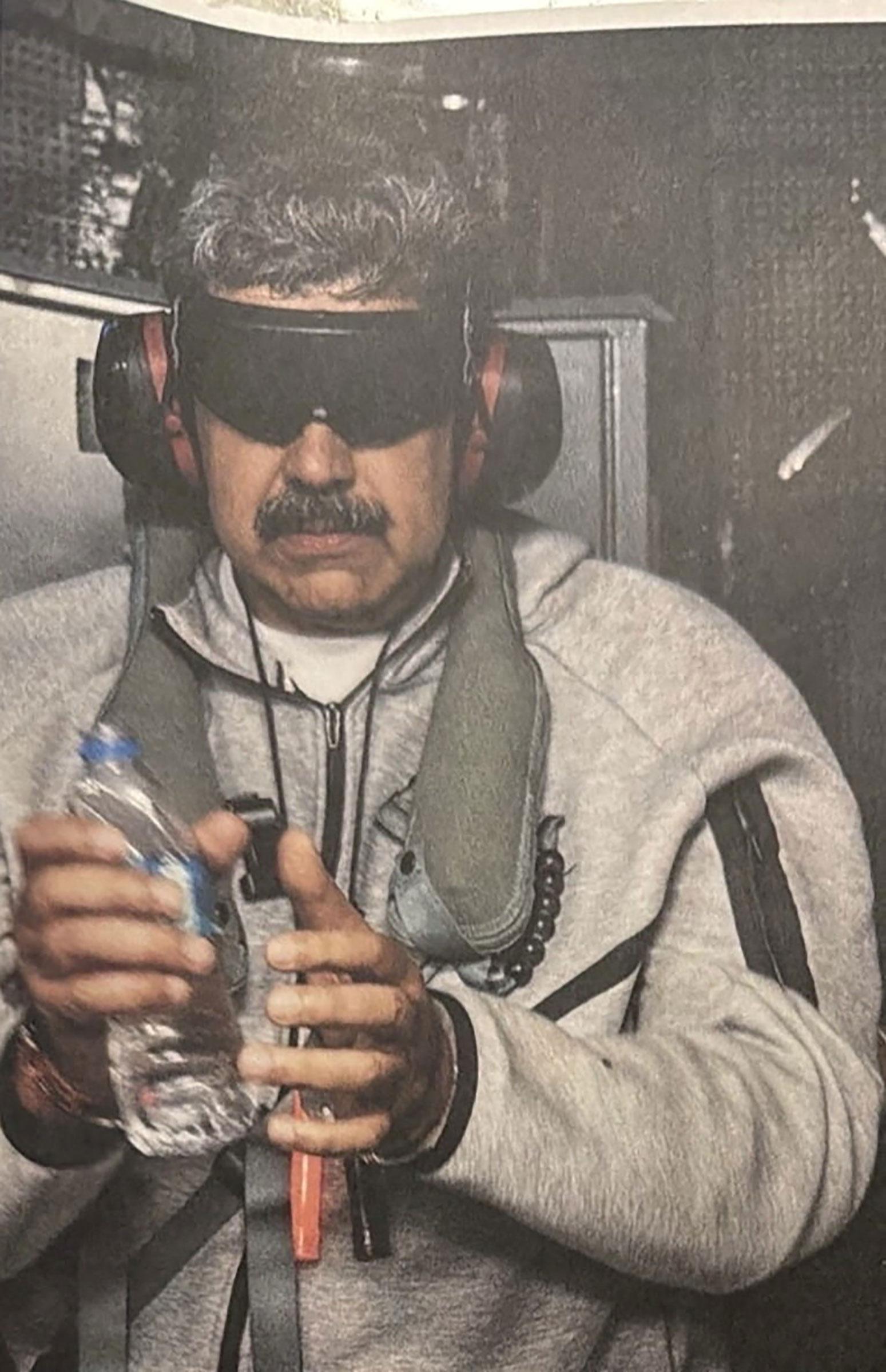
On Saturday morning, Trump posted on his Truth Social account a photo of Maduro blindfolded and in a sweatsuit aboard the ship.

A photograph which President Donald Trump posted on his Truth Social account shows what he describes as Venezuelan President @realDonaldTrump/Handout/Reuters" style="max-width:100%; height:auto; border-radius:6px; margin:10px 0;" loading="lazy" />

Why Trump authorized the operation

Trump framed the raid as both a law enforcement action and an act of war against drug trafficking networks he says are protected by the Venezuelan state.

"We had to do it because it's a war," he said, citing what he described as an armed conflict with cartels moving drugs toward the United States.

The Justice Department unsealed a new indictment on Saturday accusing Maduro and Flores of participating in a narco-terrorism conspiracy. Attorney General Pam Bondi said the couple would soon face justice "on American soil in American courts."

Still, the legal authority for the strike remains contested. Congressional leaders said the administration had not notified the Armed Services Committees in advance, and some lawmakers questioned whether the President could authorize such an operation without explicit approval from Congress.

Trump said the United States planned to oversee Venezuela until a transition of power could be arranged. "We're going to run the country until such time as we can do a safe, proper and judicious transition," he said.

Write toNik Popli atnik.popli@time.com.

How The U.S. Captured Venezuelan Leader Nicolas Maduro

President Donald Trump takes questions as he speaks to the press following military actions in Venezuela, at his Mar-a-Lago residence in Pa...
FACT FOCUS: Trump repeats false claims as he discusses US raid to extract Venezuela's president

President Donald Trump on Saturday held an extended news conference to explain theU.S. raid on Venezuelato extract President Nicolás Maduro and his wife, at times veering off topic and repeating false claims around his initiatives.

In praising the military, Trump highlighted National Guard deployments into U.S. cities, making erroneous claims about crime in Washington, D.C., Chicago and Los Angeles.

Here's a closer look at the facts.

TRUMP, discussing the impact of U.S. strikes on boats allegedly carrying drugs from Venezuela: "Each boat kills on average, 25,000 people."

THE FACTS: Trump has previously made this claim suggesting that 25,000 American lives are saved with every alleged drug boat U.S strikes "take out." But the numbers don't add up and sometimes don't exist. For example, people in the U.S. who die from drug overdoses each year are far fewer than the number of people Trump suggests have been saved by the boat strikes his administration has carried out since September.

According to thelatest preliminary datafrom the Centers of Disease Control and Prevention's National Vital Statistics System, there were up to 76,516 drug overdose deaths in the U.S. during the 12-month period that ended in April 2025, down 24.5% from the up to 101,363 for the previous 12-month period.

The U.S. military has attackedat least 35 boatsin the Caribbean Sea and eastern Pacific Ocean since strikes began on Sept. 2, most recently on Dec. 31. Using Trump's numbers, that would mean the strikes have prevented 875,000 fatal drug overdoses in the U.S — far more than the number of overdose deaths that have occurred in recent 12-month periods. This essentially implies that the administration is saving more lives than would have ever been lost.

Opioids accounted for 73.4% of drug overdose deaths in 2024,according to the CDC's State Unintentional Drug Overdose Reporting System. That includes 65.1% from illegally made fentanyls. But while the boat strikes have targeted vessels largely in the Caribbean Sea, fentanyl is typically trafficked to the U.S.overland from Mexico, where it is produced with chemicals imported from China and India.

TRUMP, discussing the National Guard deployment in Washington, D.C.: "We haven't had a killing. We had the terrorist attack a few weeks ago, a little bit of a different kind of threat. But we haven't had a killing in a long period of time. Six, seven months."

THE FACTS: Trump has alsomade this false claimbefore. There have been59 homicidesin the past seven months, including two last week, according to the latest Metropolitan Police Department statistics.

That number also includes thefatal shootingof a West Virginia National Guard member on Nov. 26 by an Afghan national. Another Guard member was injured in the shooting, which FBI Director Kash Patel said was being investigated as anact of terrorism.

The city saw126 homicidesin 2025, 29 of whichoccurred afterNational Guard troops were deployed to the nation's capital on Aug. 11.

In launching the deployment, Trumpdeclared a public safety emergencyand said his administration also would be removing homeless encampments. He said he aimed to reduce crime, but the city's attorney general said violent crime in the district reached 30-year lows in 2024 and was down an additional 26% in 2025.

TRUMP, discussing National Guard deployments in Chicago and Los Angeles: "We also helped, as you know, in Chicago. Then crime went down a little bit there ... And likewise, Los Angeles, where — we saved Los Angeles early on."

THE FACTS: Guard members were never on the streetsin Chicagoas legal challenges played out. When the Chicago deployment was challenged in court, a Justice Department lawyer said the Guard's mission would be to protect federal properties and government agents in the field, not "solving all of crime in Chicago."

Between 2020 and 2024, homicides in Chicago were down 25%. However, rape increased 27%, while robbery went up 17% and aggravated assault up 11%.

Trump deployed about 4,000 National Guard members and 700 Marines to Los Angeles in June to guard federal buildings and, later, to protect federal agents as they carried out immigration arrests.

The number of troops slowly dwindled until just several hundred were left. They were removed from the streets by Dec. 15 after a lower court ruling that also ordered control to be returned to Gov. Gavin Newsom. But an appeals court had paused the second part of the order, meaning control remained with Trump. In a Tuesday court filing, the Trump administration said it was no longer seeking a pause in that part of the order.

The U.S. Court of Appeals for the Ninth Circuit on Wednesday ordered the Trump administration to return control of the National Guard to Newsom.

Find AP Fact Checks here:https://apnews.com/APFactCheck.

FACT FOCUS: Trump repeats false claims as he discusses US raid to extract Venezuela's president

President Donald Trump on Saturday held an extended news conference to explain theU.S. raid on Venezuelato extract Presid...


ALPHA MAG © 2015 | Distributed By My Blogger Themes | Designed By Templateism.com