Who attacked a girls' school in Iran, and will there be accountability?

WASHINGTON – The search for the dead in the apparentU.S. or Israeli missile strikeon the Shajareh Tayyebehall-girls' elementary schoolin Iran has officially ended.
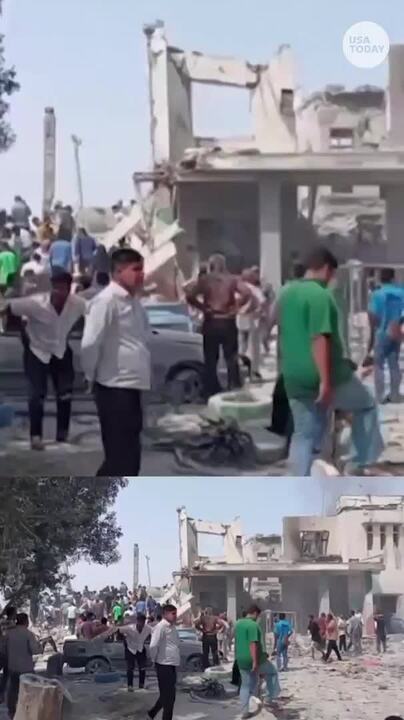
USA TODAY

But the questions surrounding the attack that killed at least 175 people have just begun, as international condemnation and calls for investigations – and accountability – were amplified on March 2.

"All alleged violations − including indiscriminate or disproportionate attacks, deliberate targeting of civilians or civilian infrastructure, and attacks on medical facilities and schools − must be promptly, independently, and transparently investigated," one of the world's oldest human rights organizations, the Paris-based International Federation for Human Rights (FIDH), said in a March 2 statement.

"Where evidence of war crimes or other serious violations is found," it added, "those responsible, regardless of rank or official capacity, must be held accountable in accordance with international law."

The Trump administration has neither ruled out nor admitted responsibility for the attack, which occurred during the opening wave of the U.S.-led operations on Feb. 28.

The Pentagon says it is reviewing the incident, but so far it has not publicly committed to a formal investigation, disciplinary action or other accountability measures.

"It would be difficult to establish a lawful basis for the strike on the school building at a time when it is full of children," David Scheffer, an international law expert who served as the first U.S. Ambassador-at-Large for War Crimes Issues, told USA TODAY. "It likely is a mistaken targeting decision or based on flawed intelligence about the use of that building."

Here's what to know.

What happened at Shajareh Tayyebeh?

The military strike on the elementary school in Minab, in the southern Hormozgan province near the Sea of Oman, is considered one of the biggest civilian casualty attacks in the newly launched U.S.-Israel war against Iran.

President Donald Trumphas defended the war as necessary in depriving a hostile enemy of nuclear weapons and missile capabilities.

The majority of victims were children, including dozens of young girls between the ages of 7 and 12, according to theIranian news agency IRNA and Iranian officials, in what they allege was an indiscriminate attack on civilians.

Hossein Kermanpour, a spokesman for Iran's health ministry,shared an X post on Feb. 28, calling the majority of those killed at the school "young child martyrs."

"God knows how many more children will be pulled out of the rubble," he wrote. "May God give their families strength and patience."

When the strike hit, the school washolding its first of multiple rotating school shifts, according to Hengaw, a Norway-based organization focusing on human rights violations in Iran. The group added that around 170 students are enrolled in the school's morning shift; however, it is unclear how many were in the building during the strike.

Why was the school struck?

It was not immediately clear why the school was targeted, but old satellite images indicate that the school was previously connected to a facility of Iran's Islamic Revolutionary Guard Corps, or IRGC. Recent satellite images from 2016 showed that the school had since been separated from the IRGC base by a wall,The New York Timesreported.

Video footage of the area circulated online appears to show that the IRGC base was also targeted in the attack, which occurred during the opening phase of the U.S.-Israeli military campaign that began Feb. 28.

Chairman of the Joint Chiefs of Staff General Dan Caine speaks during military operations in Iran, at U.S. President Donald Trump's Mar-a-Lago resort in Palm Beach, Florida, U.S. February 28, 2026. The White House/Social Media/Handout via REUTERS THIS IMAGE HAS BEEN SUPPLIED BY A THIRD PARTY. SOME AREAS BLURRED AT SOURCE.

What do US officials say?

So far, the response from the Trump administration has been muted.

The White House has not commented. The Defense Department has offered little response except to say it is probing reports of civilian casualties.

"We are aware of reports concerning civilian harm resulting from ongoing military operations. We take these reports seriously and are looking into them," said Capt. Tim Hawkins, a spokesperson for the U.S. Central Command, which oversees American military operations in the region.

Advertisement

"The protection of civilians is of utmost importance," Hawkins said, "and we will continue to take all precautions available to minimize the risk of unintended harm."

The bombing of the school did not come up at Secretary of DefensePete Hegseth's news briefing March 2 with the chairman of the Joint Chiefs of Staff, Gen. Dan Caine.

But Hegseth described the mission of the U.S. campaign, dubbed "Operation Epic Fury," as being "laser-focused" on destroying Iran's nuclear and missile capabilities.

"We're hitting them surgically, overwhelmingly and unapologetically," Hegseth told reporters.

"As the President warned," Hegseth also said, "an effort of this scope will include casualties. War is hell and always will be."

What do war crimes and humanitarian laws say?

Such attacks on schools, especially intentional ones, can be war crimes under international and even U.S. rules of engagement, legal experts told USA TODAY March 2.

At the very least, they are grounds for intensive investigations into how the target was chosen, who authorized it and whether it was intentional.

Col. Morris Davis, a former war crimes prosecutor who retired as the director of the Air Force Judiciary, said the laws of war are clear: Schools and other civilian targets cannot be targeted unless there is clear evidence that enemy forces are using the facility for operations, to store weapons, to quarter troops or for other acts of war.

A drone photo shows the damage over residential homes and a school at the impact site following a missile attack from Iran on Israel, in Bnei Brak, Israel June 16, 2025. REUTERS/Chen Kalifa

"You saw that in Gaza, where you can have a protected site that is converted to a prohibited use, and it loses protected status," Davis said.

"Obviously, this is a monumental incident and typically an investigation would be convened to determine two things," said Davis, the former chief prosecutor at the U.S. military base in Guantanamo Bay. "One is to determine accountability, and another for lessons learned. How do we prevent this from happening again?"

In an investigation, some of the questions that should be asked would include: Was the school the intended target? Was it struck while attacking the nearby IRGC facility? And if so, what intelligence supported the strike, and were civilian risk estimates conducted?

Such investigations would be ordered and overseen by the military leader in charge of that theater, according to military policy, in this case, the commander of Central Command, Davis told USA TODAY.

"But I think that's something that in the current environment, would be a good way to be unemployed come Monday," Davis said, citing remarks about the current war by Hegseth and other officials. "So do I expect anybody to be held accountable? No."

What are human rights organizations saying?

Iran's government labeled the attack on the school a war crime and demanded action by the United Nations.

UNESCO, the United Nations Educational, Scientific and Cultural Organization, alsocondemned the attackon the school as "a grave violation of humanitarian law."

FILE PHOTO: People and rescue forces work following an Israel strike on a school in Minab, Iran, February 28, 2026. Abbas Zakeri/Mehr News/WANA (West Asia News Agency) via REUTERS ATTENTION EDITORS - THIS PICTURE WAS PROVIDED BY A THIRD PARTY/File Photo

UNSecretary-General António Guterresalso condemned the attack, as well as the retaliatory strikes by Iran that hit several Middle Eastern countries.

The International Federation for Human Rights was one of numerous organizations to call on the U.S. and Israel to quickly investigate the matter to determine who ordered the strike, what information they possessed at the time.

The group singled out the attack on the school targeting civilian infrastructure, saying "a majority" of the victims were children. But it cited other reports indicating that hundreds of civilians have also been killed in various Iranian cities, including in attacks on hospitals.

Contributing: Jonathan Limehouse

This article originally appeared on USA TODAY:Rights groups want answers in attack on Iran girls school. Here's why

Who attacked a girls' school in Iran, and will there be accountability?

WASHINGTON – The search for the dead in the apparentU.S. or Israeli missile strikeon the Shajareh Tayyebehall-girls' ...
Court conference in US case against Turkey's Halkbank scheduled on Tuesday

NEW YORK, March 3 (Reuters) - A court conference is scheduled for Tuesday in the U.S. government's long-running criminal case accusing the ‌Turkish state-owned lender Halkbank of fraud, money laundering and conspiracy to ‌help Iran evade American economic sanctions.

Reuters

Lawyers for the government and Halkbank are expected to appear ​before U.S. District Judge Richard Berman in Manhattan federal court, and could shed light on the next steps in the case.

The status conference comes five months after the U.S. Supreme Court refused to consider a federal appeals court decision ‌that let the prosecution ⁠proceed.

Halkbank's case has long been a thorn in U.S.-Turkey relations, with Turkish President Tayyip Erdogan calling it an "unlawful, ugly" ⁠step.

U.S. prosecutors originally charged Halkbank in 2019, during President Donald Trump's first White House term. The case is unrelated to current tensions in the Middle East.

Halkbank was ​accused of ​using money servicers and front companies ​in Iran, Turkey and the ‌United Arab Emirates in its sanctions-evasion scheme.

Advertisement

Prosecutors said the bank secretly transferred $20 billion of restricted funds, converted oil revenue into gold and cash to benefit Iranian interests and documented fake food shipments to justify transfers of oil proceeds.

Halkbank pleaded not guilty to bank fraud, money laundering and conspiracy charges.

In ‌2023, the U.S. Supreme Court temporarily voided ​the prosecution, despite agreeing that Congress' desire to ​shield foreign countries and their ​instrumentalities from civil liability did not cover criminal cases.

Instead, ‌it ordered the 2nd U.S. Circuit ​Court of Appeals ​to more thoroughly review whether immunity under centuries-old common law shielded Halkbank.

The appeals court found no such shield in October 2024, prompting Halkbank's ​second Supreme Court appeal. ‌The Trump administration argued that the common law does not ​shield foreign state-owned companies from criminal prosecution.

(Reporting by Jonathan Stempel in ​New York; Editing by Edwina Gibbs)

Court conference in US case against Turkey's Halkbank scheduled on Tuesday

NEW YORK, March 3 (Reuters) - A court conference is scheduled for Tuesday in the U.S. government's long-running crimi...
Tariff-refund seekers flock to a little-known US court with big-case experience

March 3 (Reuters) - Importers seeking their share of more than $130 billion in tariff refunds are flocking to a little-known U.S. trade court, which must now figure out how to deal with what is expected to be an explosion of cases.

Reuters

Multinationals such as FedEx and L'Oreal and hundreds of smaller companies have filed around ‌2,000 lawsuits at the U.S. Court of International Trade in Manhattan, seeking refunds for tariffs imposed last year by President Donald Trump, according to court records. The cases ‌could be the tip of an iceberg - the tariffs that were ruled illegal by the Supreme Court on February 20 were levied on more than 300,000 importers.

The number of filings represents a dramatic increase from 2024, when only 252 new ​cases were filed in the court, according to court data.

The Supreme Court did not address refunds, leaving that to customs officials and the eight active judges on the trade court, which typically handles disputes over anti-dumping measures and import classifications on everything from window shades to pig fat.

The Supreme Court cases, which were brought by toy company Learning Resources, spirits importer VOS Selections and other importers, are now back at the trade court.

Lawyers for five of the plaintiffs suggested in a February 24 court filing that their lawsuits should serve as test cases to determine how the refunds will be calculated and ‌issued.

In the meantime, other cases would be put on hold.

Not everyone ⁠wants to wait.

Smaller importers, which make up the vast majority of companies that paid tariffs, want to bypass the process of bringing a lawsuit, which can cost thousands of dollars in legal fees.

They are hoping Customs and Border Protection will establish a simple, low-cost process for refunds, such as a dedicated ⁠web portal for entering basic information to generate a reimbursement.

Trade lawyers said CBP could require importers to go through its established administrative process that requires filing official protests. Complicating the process, refunds on tariffs paid early in 2025 might be treated differently than tariffs paid more recently.

The process, according to John Peterson, a trade lawyer who has filed cases in the current wave of tariff-refund claims, is "the mega-question."

Advertisement

CBP did not respond ​to ​a request for comment.

SIMILAR APPROACH

In their February 24 filing, the importers' lawyers reminded the trade court that it ​has experience organizing thousands of refund lawsuits, albeit involving many fewer potential ‌claimants and much less money.

A wave of refund litigation similar to the current demands for tariff reimbursements kicked off following a 1998 U.S. Supreme Court decision that struck down a tax that had been collected from exporters for 11 years.

"This court employed a similar approach with respect to the challenges to the Harbor Maintenance Fee," the court filing said.

Rather than oversee thousands of cases simultaneously, the trade court paused the lawsuits and set up a steering committee of plaintiffs' lawyers specializing in trade who then oversaw the one case that proceeded. The test case was used to litigate questions such as interest on refunds and deadlines to sue. Orders entered in the test case applied to all lawsuits.

Less than six months after the Supreme Court struck down that tax, ‌the court approved a refund process. It required each claimant to sue individually and then send a claim ​form to the CBP. If the importer and CBP disagreed or legal questions surfaced, the parties could ask the ​court to review the claim.

Within about 2-1/2 years of the Supreme Court order striking ​down the harbor tax, about $730 million was paid out to as many as 100,000 claimants, according to a paper about the case published on the ‌trade court's website.

The legal team for VOS Selections and the four other ​plaintiffs in the current litigation urged the trade court to basically ​follow that model, letting their cases proceed to establish a refund process that could be applied to everyone.

While the harbor-tax litigation provides a framework, nothing compares to the sheer volume of tariff payments that need to be unwound. As of December 10, the illegal tariffs were collected on about 34 million shipments, according to a government court filing.

"There's ​still a lot of questions that are going to need to ‌be answered, and whenever you have $133 billion at stake, there's going to be disputes," said Daniel Pickard, a trade attorney, who has not filed tariff-refund cases. "So you've ​got to think that there's going to be a whole bunch more litigation before this is all over."

(Reporting by Tom Hals in Wilmington, Delaware, and David Thomas ​in Chicago; Additional reporting by Mike Scarcella; Editing by Noeleen Walder, Amy Stevens and Ethan Smith)

Tariff-refund seekers flock to a little-known US court with big-case experience

March 3 (Reuters) - Importers seeking their share of more than $130 billion in tariff refunds are flocking to a little-kn...
Is Deion Sanders fighting for his job? Not yet, but there are issues

Colorado footballcoachDeion Sandersmight not be fighting for his job just yet. But consider this comparison as Sanders opens his fourth spring football season in Boulder this week:

USA TODAY Sports

MacIntyre had just one winning season in six years overall. Sanders has just one winning season in three. So how does Sanders veer off that similar path? By solving these three major challenges below, starting Monday, March 2, just one day afterhis team was rattled by tragic news: Backup quarterback Dominiq Ponderdied in a car accidentin Boulder County March 1.

1. Deion Sanders must break in a mostly whole new team

After finishing 3-9 last year, Sandershas a new offensive coordinator, new defensive coordinator, new running backs coach, new defensive line coach, new tight ends coach and new cornerbacks coach, along with44 new scholarship transfer playersand 12 new scholarship freshmen.

Out of 77 scholarship players on the current team, only 21 return from last year's team, according to the university. The newcomers include San Jose State transfer receiver Danny Scudero, who led the nation last year in receiving yards (1,297). Talented playmaker Boo Carter also transferred into Boulder from Tennesseeafter his dismissal from the team there in November.

Colorado's transfer class ranked No. 23 nationally, according to 247Sports. But Sanders only has 15 spring practices to work on it before the start of preseason practices and the season opener at Georgia Tech on Sept. 3.

2. Prepare the quarterback of the future

This will be an especially tough spring for Colorado quarterbacks after the sudden passing of Ponder, a non-scholarship player.

"I know that we'll we'll find a way to get through it and and honor Dom in the way that we work every day," Colorado offensive coordinator Brennan Marion said March 2.

Ponder likely would have been a backup this year behindredshirt freshman Julian Lewis, who started two games last season. Lewis, 18, has shown he has the poise and potential to be the team's new starter this year as a pro-style passer. But then Sanders changed his offensive coordinator, replacing Pat Shurmur withMarion, who runs a run-heavy Go-Go offense. That doesn't mean Lewis won't fit into that system. But it does raise questions about how well he'll fit into it.

Advertisement

Another mystery added to the intrigue recently when the Buffsconducted an internal player draftto select two intrasquad teams. In a bit of a shocker, Lewis was not the first quarterback selected, as shownin a video posted by Sanders' son Deion Jr.

Colorado teammates instead picked freshman quarterback Kaneal Sweetwyne at No. 1 overall, ahead of Lewis, who was picked No. 2. Sweetwyne is a dual-threat QB who at least gives the Buffs some options at a position that suffered a setback in 2025 after Sanders' quarterback son Shedeur left for the NFL.

3. Establish an effective defense in a hurry

Five days before the start of spring practice, defensive coordinator Robert Livingstondeparted to take a job as an assistant coach with the NFL's Denver Broncos. Colorado also confirmed Feb. 26 pass rush coordinatorWarren Sapp has leftthe coaching staff, too.

In a bit of a jam, Sanders promoted new linebackers coach Chris Marve to replace Livingston and revive a defense that regressed in 2025. Colorado ranked 111thnationally in scoring defense with 30.5 points allowed per game last year and then lost its leading tackler — safety Tawfiq Byard, who transferred to Texas A&M. But the Buffs still might be able to fill his void. They added veteran Vanderbilt safetyRandon Fontenette, who had 125 tackles the past two seasons.

A bigger question might be whether Marve is the man to get the job done. He previously served as defensive coordinator at Virginia Tech, where he was fired in 2024 after a 6-6 regular season.

If Marve fails again, will Sanders go the way of MacIntyre with two one-hit wonders between them in 2016 and 2024?

It's a question that won't need to be asked if Sanders can meet these challenges, starting Monday. The Buffs conclude their spring practice season April 11.

Follow reporter Brent Schrotenboer@Schrotenboer. Email: bschrotenb@usatoday.com

This article originally appeared on USA TODAY:Deion Sanders facing 3 big issues this spring with Colorado football

Is Deion Sanders fighting for his job? Not yet, but there are issues

Colorado footballcoachDeion Sandersmight not be fighting for his job just yet. But consider this comparison as Sanders op...
Meet the nobodies who are biggest somebodies in Trump college sports roundtable

Look, everyone, it's Tiger Woods! AndTim Tebowand the President of the United States and so many other heavy-hitting heroescoming togetherto fix college sports.

USA TODAY Sports

And none of them mean a damn thing.

Except, that is, Jeff Gold, Jere Morehead and Donde Plowman.

Who are they, you ask? Merely three surface nobodies who are the biggest somebodies inPresident Trump's scheduled Friday White House meeting to finally, mercifully, fix what's broken.

The answer of yesteryear:Looking for college football's magic bullet? It's academic eligibility

More money, more problems:Players, cash, lack of consequences. What could go wrong in NIL world?

But nothing gets done without theBig TenandSECsigning off on it, and they're not exactlyplaying nice of late. Which brings us the the big three of the event, where the rubber meets we don't have to do a thing if we don't want to.

  • Morehead, Georgia's president, is the most powerful president or chancellor in the SEC, and likely college sports. He's widely considered the most hands-on sports administrator in the nation.

  • Gold, the longtime Nebraska chancellor, led the Big Ten through its return to play during the pandemic season, steering the league clear of a dolt former commissioner's idea of spring football and — get this — two seasons in eight months.

  • Plowman, the Tennessee chancellor, is at the forefront of the push for collective bargaining, the one true answer — however it's massaged and managed into a plausible system — to gain control of pay for play and player movement.

You can have Tiger or Timmy or Condi Rice or Adam Silver (Adam Silver?). My money is on the Big Three ― Morehead, Gold and Plowman ― to make this thing work.

Because despite what you believe, despite how Big Ten commissioner Tony Petitti and SEC commissioner Greg Sankey have become the bad guys in this deal, they're simply herding cats. Or in this case, university presidents and chancellors who make every decision.

That's 18 from the Big Ten and 16 from the SEC, and those 34 men and women will be the sole reason college sports figures a way out of this mess. If it even does.

More to the point, the Big Three at the Trump meeting carry considerable weight within their university caucuses.

There's a reason Tennessee athletic director Danny White has been publicly talking about the need to collectively bargain with players — which, until now, has been last resort, last chance. Well, here we are, everyone.

The last train is leaving the station.

If White is publicly talking about collective bargaining — again, it doesn't have to be collective bargaining as we know it — he's doing it because his boss (Plowman) signed off on it. Plowman will enter that meeting full of collective bargaining research from White and his staff.

That stand-your-ground move by White comes six years after Gold fought the Big Ten — and won. He wasn't buying the cancellation of the pandemic season, and threatened to play a full schedule without the Big Ten.

Advertisement

Think about that: He was willing to go against his conference membership when dealing with the pandemic, possibly leading to Nebraska's expulsion had the Big Ten membership not eventually figured out the lunacy of not playing.

To say nothing of the potential lawsuits from injured players after playing two seasons in eight months (seriously, how dumb was that idea?).

Can Trump fix college sports?Can't sell plan if SEC, Big Ten don't want to hear it

Then there's Morehead, the most powerful player in the most powerful conference in college sports. The conference that could, if it wanted to, break away and make billions as the most-watched product in college sports. By a long way.

Morehead could bring the SEC presidents and chancellors together, and be part of the answer. Instead of being part of the problem.

Look, the SEC and Big Ten could survive in this ever-changing, eat what you kill world. It wouldn't be easy, and there would be annual fires to put out — some costing hundreds of millions of dollars in potential legal losses — but it could be done.

They could survive even without an antitrust exemption. Hell, they're doing it now.

But at what cost, and do they want to be seen as the two conferences that killed college sports as we know it?

Here's why this meeting could actually work, beyond how they eventually figure out the machinations of it all: Who blinks first? The SEC or the Big Ten?

Be the first conference to join the other side, and you're forever seen as the conference that saved college sports. Be the conference that follows, and you're forever seen as being dragged, kicking and screaming, to the answer.

This isn't about Trump, though his bully pulpit helps. This isn't about Nick Saban and his championships, or Tony Dungy or an NFL owner or the reality that no players or player representatives have been asked to attend.

Nothing changes without the Big Ten and SEC saying it does.

And the three surface nobodies who are the biggest somebodies to finally making it happen.

Matt Hayesis the senior national college football writer for USA TODAY Sports Network. Follow him on X at@MattHayesCFB.

This article originally appeared on USA TODAY:The most important people at Trump's college sports roundtable

Meet the nobodies who are biggest somebodies in Trump college sports roundtable

Look, everyone, it's Tiger Woods! AndTim Tebowand the President of the United States and so many other heavy-hitting ...


ALPHA MAG © 2015 | Distributed By My Blogger Themes | Designed By Templateism.com