


WASHINGTON – A federal judge has given the Justice Department until Feb. 5 to explain how much "victim identifying information" it failed to redact from therecently released Epstein filesafter accusers of the disgraced late financier Jeffrey Epstein said they were getting death threats as a result.
United States District Judge Paul Engelmayer also instructed DOJ to address whether "all such materials" have since been blacked out in the 3.5 million Epstein-related emails, photos, videos and other data from its investigative files that it made public Jan. 30.
Engelmayer's Feb. 3 order came in response to a legal filing by two lawyers representing Epstein survivors "regarding an unfolding emergency that requires immediate judicial intervention" – including an immediate takedown of the Justice Department website hosting the Epstein files until they can be purged of everything identifying his accusers.


 What appears to be outdoor furniture is seen in a photo released by US Department of Justice from one of Jeffrey Epstein's properties." style="max-width:100%; height:auto; border-radius:6px; margin:10px 0;" loading="lazy" />


Inside Epstein homes: See odd items that raise more questions than answers
Lawyers Bradley Edwards and Brittany Henderson, who said they represent dozens of Epstein accusers, also asked the court to appoint an independent special master to oversee redaction and republication of the DOJ files, and to keep open the chance for judicial sanctions, "including contempt and monetary relief."
"For the victims of Jeffrey Epstein, every hour matters. The harm is ongoing and irreversible," the lawyers wrote in a detail-filled seven page filing. "This Court is the last line of defense for victims who were promised protection and instead were exposed. Judicial intervention is not merely appropriate – it is essential."
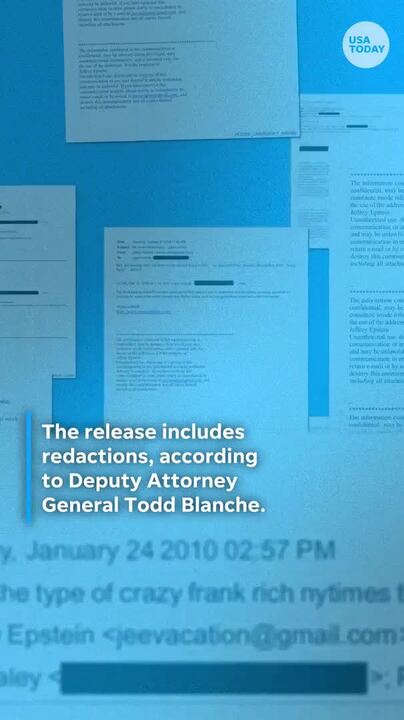
Deputy Attorney General Todd Blanche said in announcing the new release Jan. 30 that images of all women in the files – with the exception of convicted Epstein associateGhislaine Maxwell– would be redacted in an effort to ensure that no personal details would be made public.
But in the first 48 hours since the files' Jan. 30 release, Edwards and Henderson said they reported to DOJ "thousands of redaction failures on behalf of nearly 100 individual survivors whose lives have been turned upside down by DOJ's latest release."
Besides receiving death threats, some Epstein accusers overseas who had wanted to remain anonymous have had to contend with media reports publishing their identities and photos, the lawyers said.
Other victims have also gone public with similar accusations about how DOJ made their identities public after promising not to, while keeping secret the identities of potential Epstein accomplices.
"There is no conceivable degree of institutional incompetence sufficient to explain the scale, consistency, and persistence of the failures that occurred," Edwards and Henderson wrote, "particularly where the sole task ordered by the Court and repeatedly emphasized by DOJ was simple: redact known victim names before publication."
All the Justice Department needed to do, they told Engelmayer, was to type each victim's name into its own search function and then redact it before making the files public in itsonline "Epstein Library"database.
"Had DOJ done that," they said, "the harm would have been avoided."
Instead, the DOJ on Jan. 30 "committed what may be the single most egregious violation of victim privacy in one day in United States history," Edwards and Henderson wrote.
DOJ acknowledges failures. Survivors say that's not enough.
A department spokesman did not immediately respond to USA TODAY's request for comment Feb. 5 on whether DOJ would meet the judge's deadline.
In a statement to USA TODAY, the Justice Department said it "takes victim protection very seriously and has redacted thousands of victim names in the millions of published pages to protect the innocent."
"When a victim's name is alleged to be unredacted," DOJ said, "our team is working around the clock to fix the issue and republish appropriately redacted pages as soon as possible."
'Immediate judicial intervention' needed to protect accusers
The seven-page filing by Edwards and Henderson is full of examples of what they say are DOJ's failure to redact information pertaining to women dating to back to an earlier release of files released Dec. 19, 2025, as required under the Epstein Files Transparency Act that went into effect a month earlier.
The next day, Dec. 20, they said, they immediately notified DOJ of "hundreds of redaction failures" that required urgent attention, including unredacted names and dates of birth.
One document alone identified more than 30 victims according to their motion for "immediate judicial intervention."
That failure, the lawyers said, forced the Epstein survivors to stay up "all night using DOJ's search bar to identify and read every single document that was posted publicly identifying them despite being promised by your office that this would never happen."
In all, Epstein is believed to have victimized girls and young women over potentially several decades, forcing them into sex acts at his estates in New York, Florida, New Mexico and on his private Caribbean island.
Many of Epstein's estimated 1,000 to 1,200 victims cooperated with FBI agents and federal prosecutors over the years, and have insisted that their identities − and their involvement in investigations − remain anonymous. Some of the Epstein survivors were minors at the time of the alleged abuse.
Advertisement
But when some Epstein survivors or their lawyers contacted DOJ to request redactions, DOJ often blacked out some identifying information while leaving other data in the files, the lawyers said.
Many victims' concerns were compounded dramatically by the Jan. 30 release of exponentially more DOJ files – and more sensitive information about them and the nature of their allegations. Democratic lawmakers and other critics have called on the Justice Department to act immediately to protect them from further harm.
Maxwell was convicted of related crimes and sentenced to 20 years in prison that she is currently serving. Epstein died by suicide in 2019 after his arrest on similar charges while in a New York jail awaiting prosecution.
One DOJ document listing the names of 32 minor child victims
In their legal filing, the lawyers ticked off a litany of alleged DOJ failures, including one minor victim who had her name revealed 20 times in a single document.
"After reporting the violation," the lawyers said, "DOJ redacted her name three additional times—leaving 17 instances still unredacted as of this filing."
Another email listed 32 minor child victims, with only one name redacted and 31 left visible—despite DOJ's possession of those names, the lawyers said.
Their demand for immediate injunctive relief also contends that:
FBI victim statements known as "302 reports" contained the full and unredacted first and last names of minor victims.
Handwritten FBI interview notes included minor victims' full names unredacted at the top and throughout.
Documents containing victims' names alongside dates of birth, bank information, driver's license numbers, email addresses or home addresses.
Documents where victims' names are redacted in some places but not others within the same document.
Documents where redactions are "pencil-thin," revealing the complete name and email address beneath.
Documents where photographs are properly redacted in one instance and appear fully unredacted nearby.
Hundreds of documents exposing the names of four women who have been in "near-constant communication with DOJ since December requesting protection."
As a result of those redaction failures, 20 clients who say they are Epstein survivors agreed to issue statements as part of the emergency appeal to the judge, the lawyers said.
'My life is in imminent danger,' one survivor tells DOJ
"It is so wrong on so many levels," said one, identified as Jane Doe 3. "Not only it (sic) exposes victims to potential abuse or blackmail, but it can ruin families or damage our careers. I am horrified."
Some said they are overseas, where newspapers and websites are publishing all of the details that were not supposed to be linked to them, including photos.
"How is this possible?" asked Jane Doe 4. "In [my home country], as in the entire EU, there is a strict privacy law. I'm shocked, I didn't expect such violation of our privacy."
Some noted that while dozens of Epstein accusers went public with their allegations, they had insisted on anonymity to protect their privacy – and said that has now been shattered and placed them and their families at risk.
"Please, I'm begging you to delete my name!!!" said Jane Doe 5. "I can only imagine the devastation your errors are causing to so many other victims of Jeffrey Epstein."
Jane Doe 7 said the release of her name and photo have resulted in unwanted publicity and threats in her home country where she currently lives.
"The press makes up crazy stories and shows me as a legitimate target for others to attack me physically and in the press," Jane Doe 7 said. "My life is in imminent danger as long as you keep on releasing more files and info about me and not remove and redact the ones already released."
She added: "This is a life-threatening situation for me. Please take my plea seriously."
Jane Doe 8 said she also received death threats in the 24 hours following the Jan. 30 DOJ release, which she said included 51 entries mentioning her.
"You even had the audacity to release my private banking info and [I] am now trying to shut down cards and accounts," Jane Doe 8 said. "This kind of vicious attack on a victim at the hands of the 'Department of Justice' is an abomination."
In their filing, the lawyers said the Justice Department needs to do more to ensure that all names and identifying information are redacted immediately to prevent further harm.
Besides an immediate takedown of the files, they asked the court to appoint an independent special master to oversee redaction and republication, and to keep open the chance for judicial sanctions, "including contempt and monetary relief."
"For the victims of Jeffrey Epstein, every hour matters. The harm is ongoing and irreversible," the lawyers said. "This Court is the last line of defense for victims who were promised protection and instead were exposed. Judicial intervention is not merely appropriate – it is essential."
This article originally appeared on USA TODAY:'Every hour matters.' Judge orders DOJ to protect Epstein survivor IDs


