Capybaras share riverbanks with crocodiles, but the peace treaty is less friendly than it looksRodielon Putol Mon, October 12, 2026 at 3:35 PM UTC

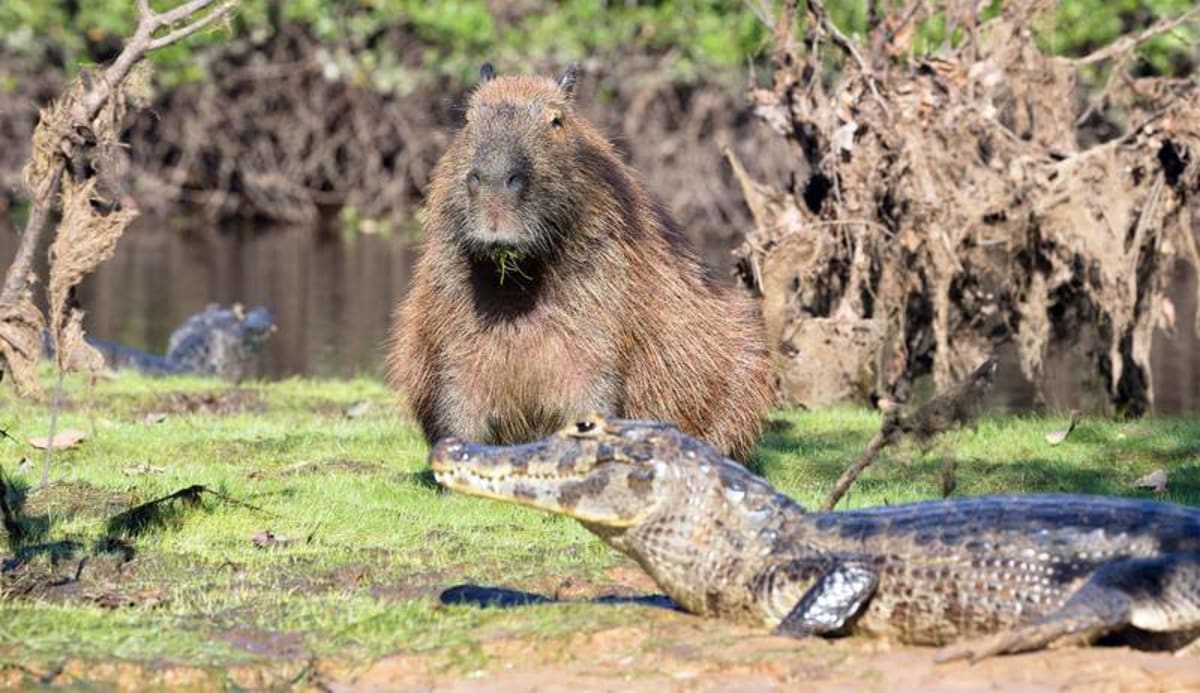
Capybara sharing a river bank with a crocodile. Credit: ShutterstockPhotos of capybaras dozing beside caimans have turned the world’s largest rodent into an internet symbol of calm. Some viral posts go further and describe the two animals as friends.
Photos of capybaras dozing beside caimans have turned the world’s largest rodent into an internet symbol of calm. Some viral posts go further and describe the two animals as friends.
Field research tells a more practical story. Caimans rarely bother adult capybaras, but young capybaras are on the menu, and both species share the wetlands with a predator that hunts them.
The apparent truce has less to do with friendship than with size, risk and an easier supply of food.
Neighbors at the water’s edge
Capybaras, Hydrochoerus hydrochaeris, live in groups around rivers, lakes and marshes across much of South America. They graze on land but rely on water to escape danger.
Caimans, close relatives of alligators, use the same habitats. In Brazil’s Pantanal, one of the world’s largest wetlands, yacare caimans and capybaras often share the same shallow waters and banks.
That overlap produces the scenes people love to share: a capybara grazing a few feet from a basking caiman, or resting on the bank while a caiman floats nearby.
Some photos even show capybaras sitting on caimans. To many viewers, that looks like trust.
What caimans actually eat
A study published in 1996 in the Herpetological Journal examined the stomach contents of 196 yacare caimans in the Pantanal during the dry season.
The researchers found that the caimans “ate mostly insects and fish.” Their diets varied between habitats, but not between caimans of different sizes.
For a caiman, a fish is far easier to catch and handle than a large, alert mammal.
Elizabeth Congdon, an assistant professor at Bethune-Cookman University in Florida and a capybara expert, explained why encounters between the two species usually stay peaceful.
“It is very unusual to see crocodilians hunt and eat capybara in the wild,” she told IFLScience.
“It is rare, especially when there are plenty of fish and easier prey to handle than a capybara. I have seen them in the wild sleeping next to each other,” she said.
Not worth the risk
An adult capybara is a heavy, muscular animal with long, sharp incisors. Tackling one could injure a caiman.
“Capybaras have big, sharp teeth. Combined with their body size, I think they are just not worth the trouble and risk of injury,” said Congdon.
Young capybaras are a different matter.
“The exception is the babies. Babies are snacks for lots of things – even birds of prey,” she added.
A fact sheet from the San Diego Zoo Wildlife Alliance library lists caimans among the predators of juvenile capybaras, alongside foxes, ocelots, raptors and anacondas. Pumas and jaguars can kill adults.
Some of those predators are formidable. Recent genetic work suggests South America’s giant green anacondas include two distinct species, one of them notably larger than the other.
A shared predator
The friendly image also hides a third player. In the Pantanal, jaguars hunt both caimans and capybaras.
A study published in the Journal of Mammalogy followed 10 jaguars fitted with GPS collars in the southern Pantanal between 2001 and 2004. Researchers documented 438 prey items at kill sites.
Caimans made up 24.4 percent of those kills, second only to cattle. Capybaras accounted for 2 percent.
Predation on caimans rose as water levels climbed and the reptiles spread out across the flooded landscape. Female jaguars killed more caimans than males did.
Jaguars in some parts of the Pantanal focus heavily on aquatic prey such as fish and caimans. In that setting, the riverbank is not a safe zone for either animal.
How capybaras stay safe
Capybaras do not ignore danger. When a group member senses a threat, it gives an alarm call, and the others either stand alert or plunge into the nearest water.
Water is their main escape route from land predators. Capybaras are strong swimmers and can stay underwater for up to five minutes, according to the San Diego Zoo Wildlife Alliance.
When attacked on land, groups may form a defensive huddle, with the young in the middle and adults facing outward.
A 2022 study compared capybaras in the Pantanal, where jaguars and pumas are common, with capybaras in Argentina’s Iberá wetlands, where large predators disappeared in the mid-20th century and a jaguar reintroduction led by Rewilding Argentina was underway.
Pantanal capybaras lived in smaller groups, averaging eight animals compared with 15 in Iberá. They also stayed closer to water and spent more of their time feeding, about 60 percent versus 40 percent.
“In areas with predators, capybaras may reduce predation risk by choosing safer areas, where they can spend more time foraging when predators are not nearby,” wrote the authors.
Reading the viral photos
The study also noted that in Iberá, young capybaras were occasionally taken by ocelots, feral pigs, foxes and caimans. Even without jaguars, the youngest animals face real risks.
So when an adult capybara rests calmly next to a caiman, the odds are on its side. Caimans mostly eat fish and insects, and a full-grown capybara is a risky target.
That calm can change quickly if a young capybara strays too close, or if a jaguar appears on the bank.
Caimans and other crocodilians play important roles in wetland ecosystems, and capybaras have deep roots there too. Fossils show that extinct capybara relatives once lived in places as dry today as the Atacama Desert.
The full study was published in the journal Animal Behaviour.
—–
Like what you read? Subscribe to our newsletter for engaging articles, exclusive content, and the latest updates.
Check us out on EarthSnap, a free app brought to you by Eric Ralls and Earth.com.
—–
Source: Nature