Texas Mom, Dad, and Teenage Son Charged in $3 Million Luxury Car Theft Ring That Shipped Vehicles as Rebar

Photo Houston Police DepartmentA Texas couple and their teenage son are among five people charged in a luxury vehicle theft operation that allegedly exploited the transportation system used to deliver expensive cars across the country. Instead of breaking ... Read more
A Texas couple and their teenage son are among five people charged in a luxury vehicle theft operation that allegedly exploited the transportation system used to deliver expensive cars across the country. Instead of breaking into parked vehicles, the suspects reportedly manipulated shipping arrangements so legitimate transport drivers delivered cars to people who were never supposed to receive them.
The targets included Lamborghinis, Rolls-Royces, Bentleys, Range Rovers, Mercedes-Benz models, and Cadillac Escalades. Houston police say the operation involved disabling tracking devices, concealing vehicles in commercial parking lots, and arranging shipments through East Coast ports.
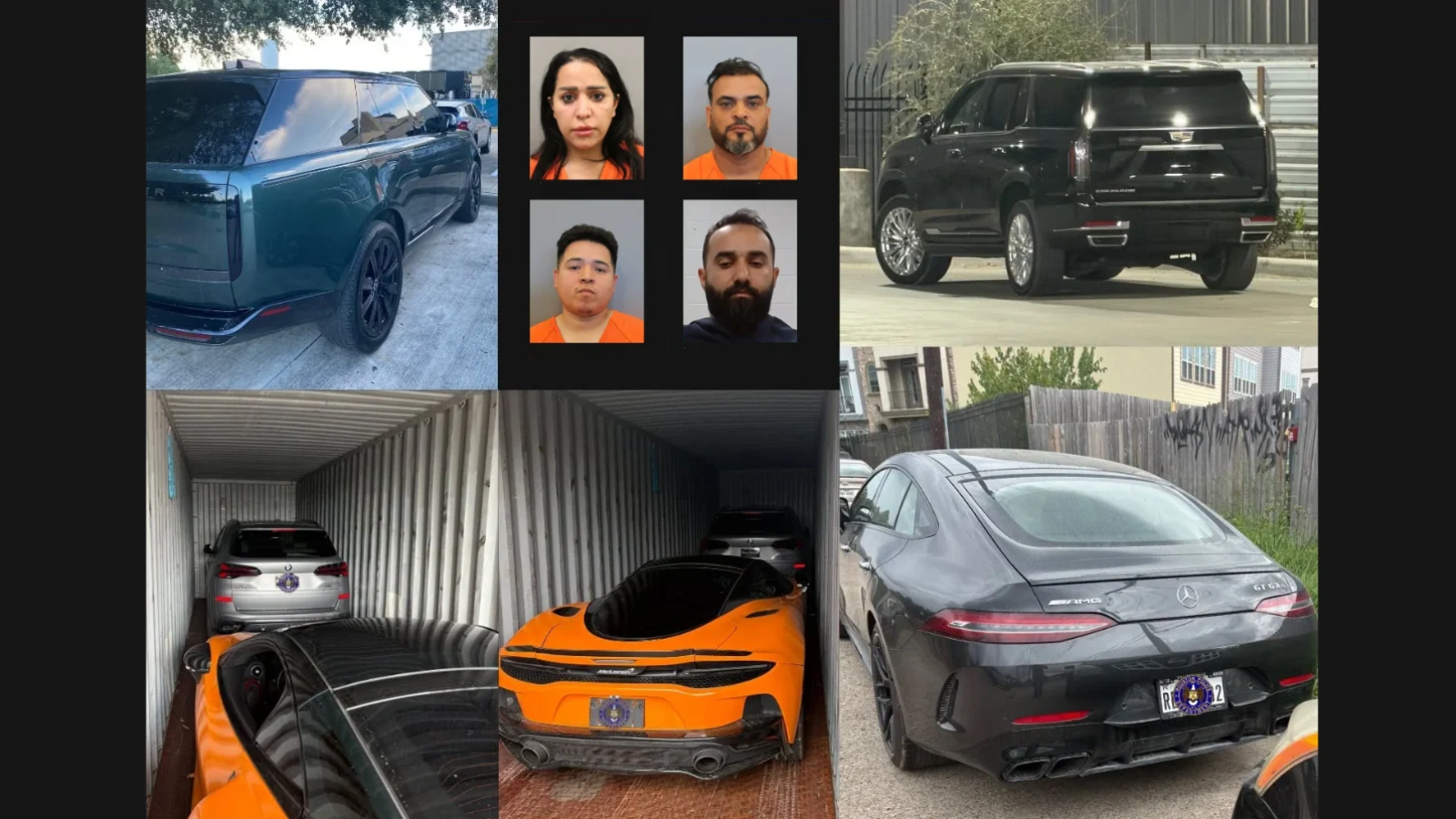
Some of the stolen vehicles were discovered inside shipping containers labeled as carrying rebar, the steel reinforcement material used in concrete construction. By the time investigators located them, the cars were reportedly being prepared for export.
The Houston Police Department announced that its Auto Theft Division recovered 15 luxury vehicles valued at approximately $3 million and arrested four adults and one juvenile. Investigators believe the operation may have been active for years, although the 15 vehicles were linked to approximately three months of investigative work.
A Family Business Under Investigation
The adult defendants are Dheyaa Thabit Abd, 41; his wife, Iman Ouda Al Saedi, 35; Matthew Gonzalez, 29; and Saifuldeen Al Gburi, 30. The couple's teenage son is also implicated in the case, but police have not publicly identified him because he is a juvenile.
The three family members allegedly helped collect diverted vehicles and conduct counter-surveillance, according to Sgt. Ben LeBlanc of HPD's Auto Theft Division, who discussed the investigation with KPRC 2 News. The family also reportedly worked with Gonzalez and Al Gburi to move vehicles into temporary storage locations.
Abd and Al Saedi operated a mechanics business in southwest Houston. LeBlanc said some people associated with the shop were paid to retrieve vehicles, while ABC13 reported that Houston officers searched the business near Fondren and Richmond on October 7, two days before the couple appeared in court.
Houston police shared photographs of the four adult defendants and several recovered vehicles in their official announcement.
The Delivery That Never Reached Its Owner
Investigators described two methods used to intercept vehicles entrusted to legitimate transportation companies.
In some cases, suspects allegedly impersonated owners or customers and arranged to collect vehicles directly from transport drivers. In others, they reportedly posed as transportation companies to obtain shipping assignments and vehicle information before contacting legitimate carriers to change delivery instructions.
The deception allowed the group to anticipate when and where valuable cars would arrive. Drivers carrying out what appeared to be legitimate deliveries could unknowingly surrender the vehicles to unauthorized recipients.
The reported victims included people shipping their cars during moves or after purchases, as well as dealerships and auction houses. Investigators began uncovering the operation after reports of stolen vehicles whose tracking systems showed their last known locations in Houston, including cars that had originated in other states.
Once the group obtained a vehicle, police say its factory-installed tracking equipment was disabled, and the car was moved to a commercial parking lot. The vehicles remained at these locations for hours or sometimes days during what investigators described as a cooling-off period before being moved again.
The final stage allegedly involved transporting the cars toward East Coast shipping facilities. HPD coordinated with the New York Police Department and New Jersey State Police to recover some vehicles at the Port of New York and New Jersey, where shipping containers disguised their contents as construction materials.
Police have not disclosed the intended overseas recipients, and the department has not said that all 15 recovered vehicles were discovered at the port.
The Shipping System
A Harris County prosecution filing obtained and reviewed by Guessing Headlights alleges that Abd and his co-defendants participated in a scheme to hack the Central Dispatch database and redirect high-end vehicle shipments to different delivery locations.
The allegation appears in an October 9 motion requesting $150,000 bail for Abd, with prosecutors citing combined thefts exceeding $3 million.
Central Dispatch, a platform used by automobile shippers and transport carriers, disputes the suggestion that its system was hacked. A company spokesperson told KPRC that it had found no evidence of a platform breach and explained that transportation fraud frequently involves phishing and social engineering designed to obtain legitimate users' credentials.
That leaves an important part of the operation unresolved. Someone using stolen account credentials could manipulate shipping instructions without compromising the platform's underlying database, but the available court filings do not establish whether that occurred in this case.
The distinction is consequential because a transport company can maintain a technically secure platform while individual users remain vulnerable to impersonation and credential theft. Investigators have not publicly established the specific means by which the suspects allegedly obtained access to shipment details.
Court Records
The criminal complaint filed against Abd on October 9 identifies the alleged group as Abd, Al Saedi, Gonzalez, Al Gburi, and the juvenile, identified by initials. Prosecutors accuse them of participating in an organized combination that committed aggregate theft involving property worth at least $300,000 between August 1, 2025, and September 15, 2026.
The $300,000 amount is the threshold specified in the charging allegation, while the separate $3 million figure reflects the reported value of the broader operation. Neither figure independently establishes how much property any particular defendant personally handled.
Abd's case is assigned to Harris County's 184th District Court. Although prosecutors requested $150,000 bail, the court set his bond at $100,000, which he subsequently posted.
Court documents dated October 12 show that Abd was placed under GPS monitoring and required to surrender his passport, comply with travel restrictions, and avoid contact with specified co-defendants. His next scheduled court appearance is November 18, 2026.
KPRC reported that Al Saedi also posted a $100,000 bond and Gonzalez posted a $50,000 bond. Al Gburi, who was arrested in Collin County on October 14, remained in custody as of the station's October 15 report.
The charging documents identify participants in the alleged operation but do not establish who directed it or specify each defendant's individual responsibilities.
The Safeguard Hidden in the Paperwork
LeBlanc described the case as the first operation of its kind resulting in arrests by HPD's Auto Theft Division, although he acknowledged that similar schemes have become increasingly familiar to law enforcement agencies across the country.
The reported method exposes a particular vulnerability in vehicle shipping: an automobile can be transported securely, remain undamaged, and still disappear because someone changes the instructions governing its delivery.
For people arranging vehicle transportation, LeBlanc recommends researching carriers, carefully reviewing invoices and shipping documents, and independently confirming changes to delivery instructions. Dealerships should also verify the destination with customers before releasing vehicles to transport companies.
A bill of lading records important shipment details, including the vehicle and its intended delivery arrangements. Checking that paperwork against independently confirmed instructions can help identify discrepancies before possession changes hands.
The Houston investigation illustrates the potential consequences when an expensive vehicle reaches the wrong recipient through what otherwise appears to be an ordinary transportation transaction.
All defendants are presumed innocent unless and until proven guilty in court.
Source: Crime